


Behind the Hype of Vibe Coding: Turning Ideas Into Dream Products

Julia Teryokhina, Head of Engineering
Last updated: April 15, 2026
Over the past few years, we’ve entered a new era where AI isn’t a “nice-to-have” anymore — it’s the default. Almost every new software startup now involves artificial intelligence in some form. With vibe coding, it looks almost magical — you describe what you want, give AI a direction, and boom: a working product appears. No deep tech skills, no long dev cycles. Just ideas turning into apps in hours.
But once the entry barrier dropped, the success rate didn’t magically improve. According to industry estimates, up to 70–80% of AI-built startups fail, and turning a “working demo” into a secure, scalable product often requires serious engineering effort with budgets ranging from $50K to $500K.
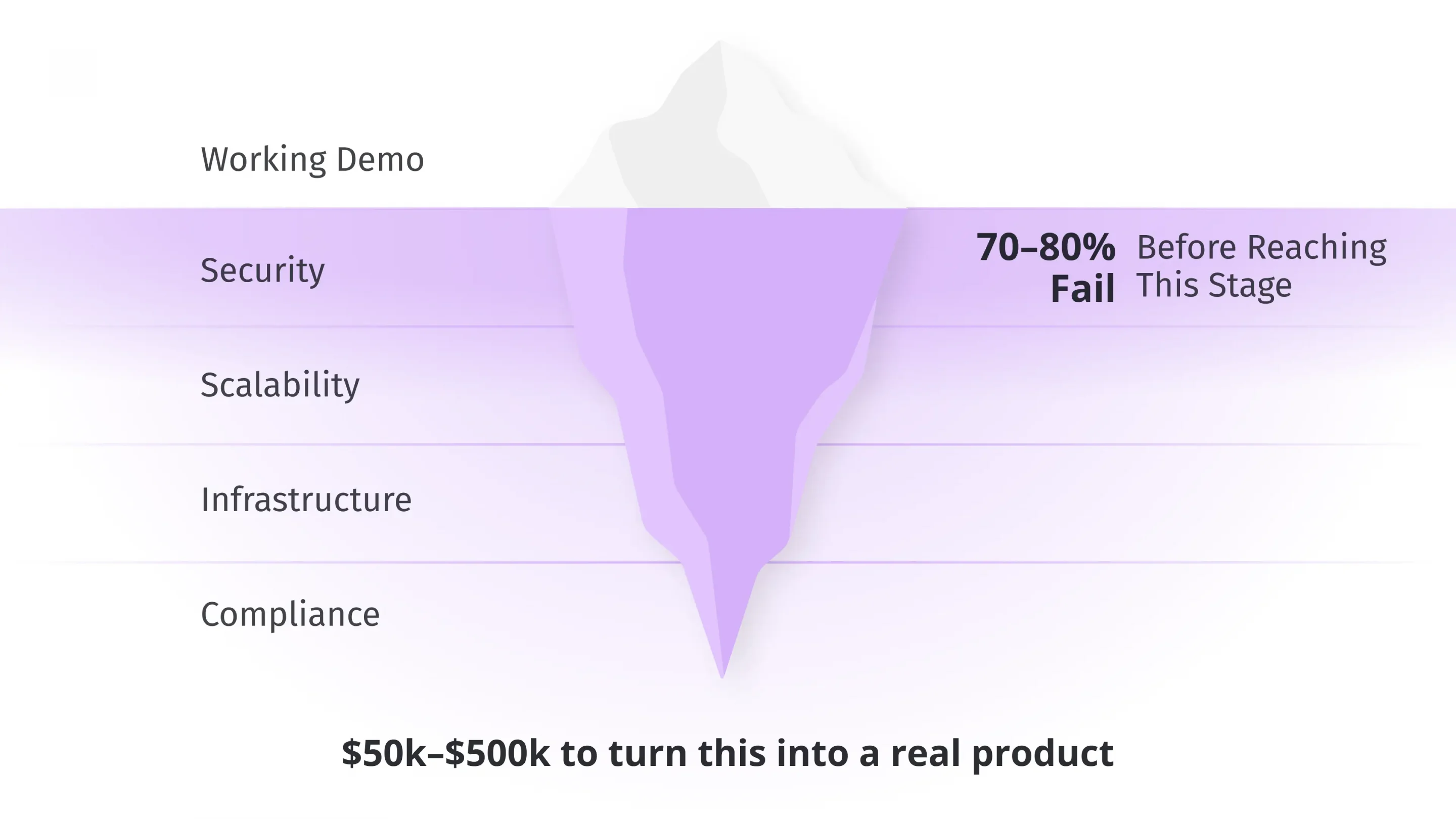
So what’s really going on, and where do AI coding tools actually shine? Let’s break it down together with Timspark.
Vibe Coding: The Idea in a Nutshell
What is vibe coding? It is a new way of building software where you don’t write everything line by line — you guide no-code tools with intent instead. No more strict specs, you just speak to AI, providing the “vibe” of your future product, and your smart assistant turns it into working features.
Sounds great — and it really is. The most obvious pros are clear:
-
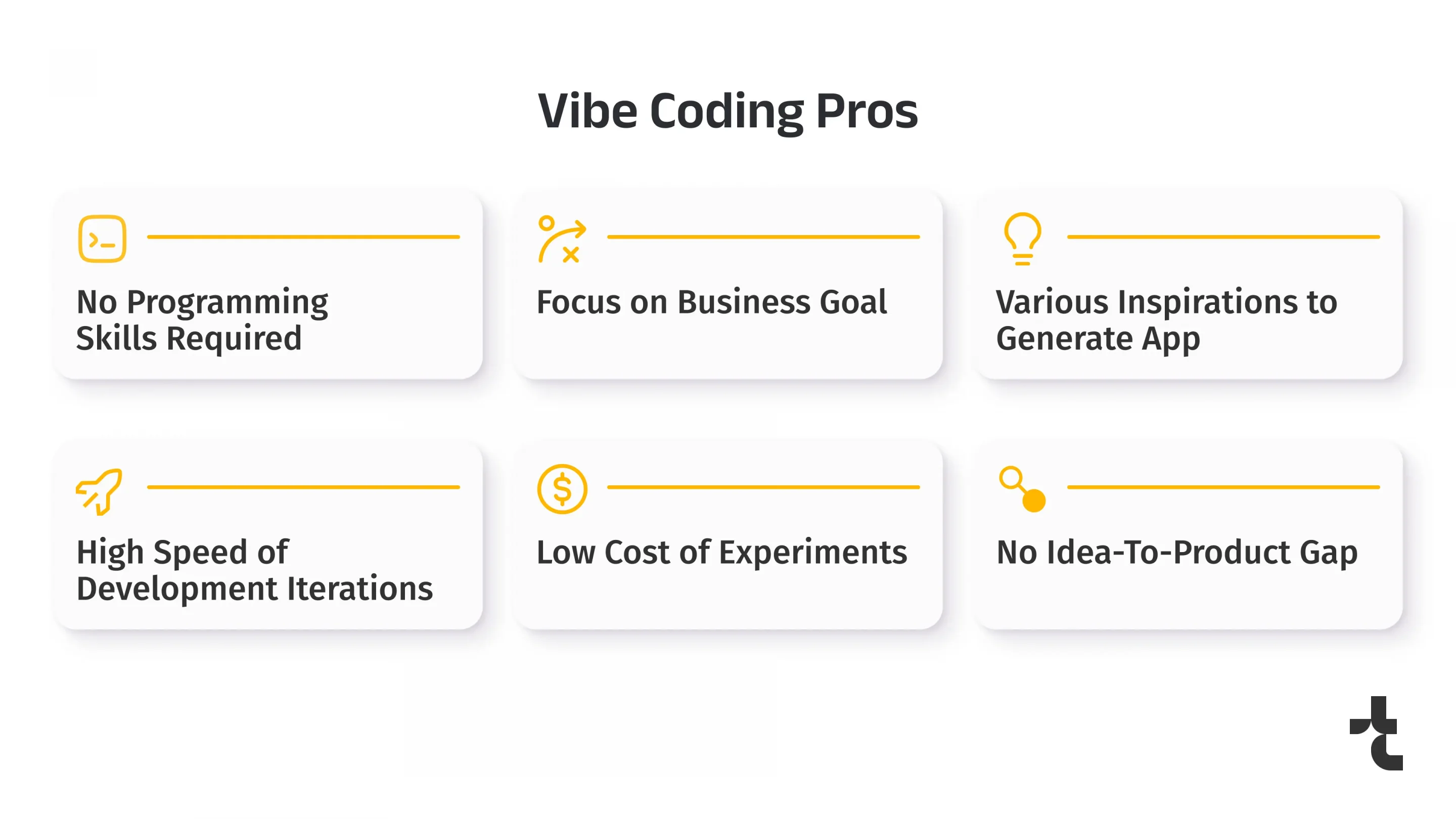
- You don’t need programming skills, which for many founders is a huge unlock, especially in a world where tech stacks evolve faster than people can keep up.
- You stop obsessing over technical implementation and focus on the business itself: what your “Silicon Valley dream” software should do, who it is for, and what actually makes it stand out.
- AI coding tools can work with much richer input than traditional dev processes — you can feed them inspirations like color palettes, screenshots, slogans, or even reference products to shape the direction of your idea.
- You get extreme speed of iteration, testing multiple versions of the same idea in hours instead of weeks.
- The cost of experimentation becomes dramatically lower, since you don’t need a full dev team or heavy infrastructure just to validate a direction.
- You compress the idea-to-product gap, going from thought to working prototype almost instantly, which often unlocks more creativity and bolder thinking.
Thus, it is less about writing code and more about designing the “feel” of your next big thing — and maybe hoping the AI didn’t take it too literally!
Top 5 Low-Code Platforms for Vibe-Driven Development
But what exactly are the best no-code solutions for non-tech creators? We won’t dive into well-known AI tools like Cursor, Claude, Windsurf, or Gemini here — while powerful, they are often used within development workflows or require some technical setup. Instead, we’ll focus on more business-friendly low-code and AI building platforms that run in the cloud, offer flexible plans or usage credits, and are designed to turn ideas into working applications quickly.
So here’s our top 5: Lovable, Base44, Wix Vibe, Bolt, and v0 by Vercel. You can compare them in the table below:
Criteria | Lovable | Base44 | Wix Vibe | Bolt | v0 (Vercel) |
What you can create | Full-stack web app (UI, backend, and database included). | Full-stack web app (UI, backend, and database included). | Websites with built-in CMS, hosting, SEO tools, and analytics | Full-stack web apps & websites | Full-stack web apps (frontend-first, integration-based backend) |
Easy to use | Easy | Moderate | Very easy | Challenging | Challenging |
Target users | Non-technical users, founders, product teams | Startup builders (semi/non-technical) | Non-technical users | Semi-technical users | Both technical & non-technical users |
Input method | Plain language + UI inspiration (UI prefs, references) | Plain language + limited visuals (screenshots/mockups) | Plain language + rich visual inputs (images, Figma, websites) | Plain language prompts + optional imported code | Plain language + existing codebases |
Iterative refinement | Strong iterative refinement of features and requirements | Limited iterative refinement after initial generation (structured, constrained changes) | Strong iterative refinement through visual editing + prompts | Strong iterative refinement through prompts and manual code editing in a dev environment | Strong iterative refinement through prompt-based changes inside real codebases |
Code access | Full access to codebase | Partial (frontend exportable) | No real code export | Full access. Provides a live coding workspace with file system, terminal, and real-time preview | Full access + GitHub integration |
Hosting / lock-in | Low lock-in (exportable code, but initial infra is platform-managed) | Partial lock-in (backend & DB remain platform-dependent) | Strong lock-in (Wix ecosystem) | No lock-in | No lock-in |
Pricing model | Credit-based (Free / Enterprise - price depends on company size and usage) | Credit-based (Free / Elite $160/mo) | Freemium (Light $17 / Business Elite $159/mo) | Token-based (Free / Enterprise - with custom quotes tailored to the team’s specific needs) | Credit-based (Free / Enterprise - pricing available based on organizational needs) |
The Hidden Downsides of Vibe Coding
Using AI for software development feels like a cheat code at first — fast builds, instant results, zero friction. But once the hype fades, founders start hitting real problems with vibe coding. What felt like a sprint suddenly turns into a grind.
Let’s look at the key cons:
-
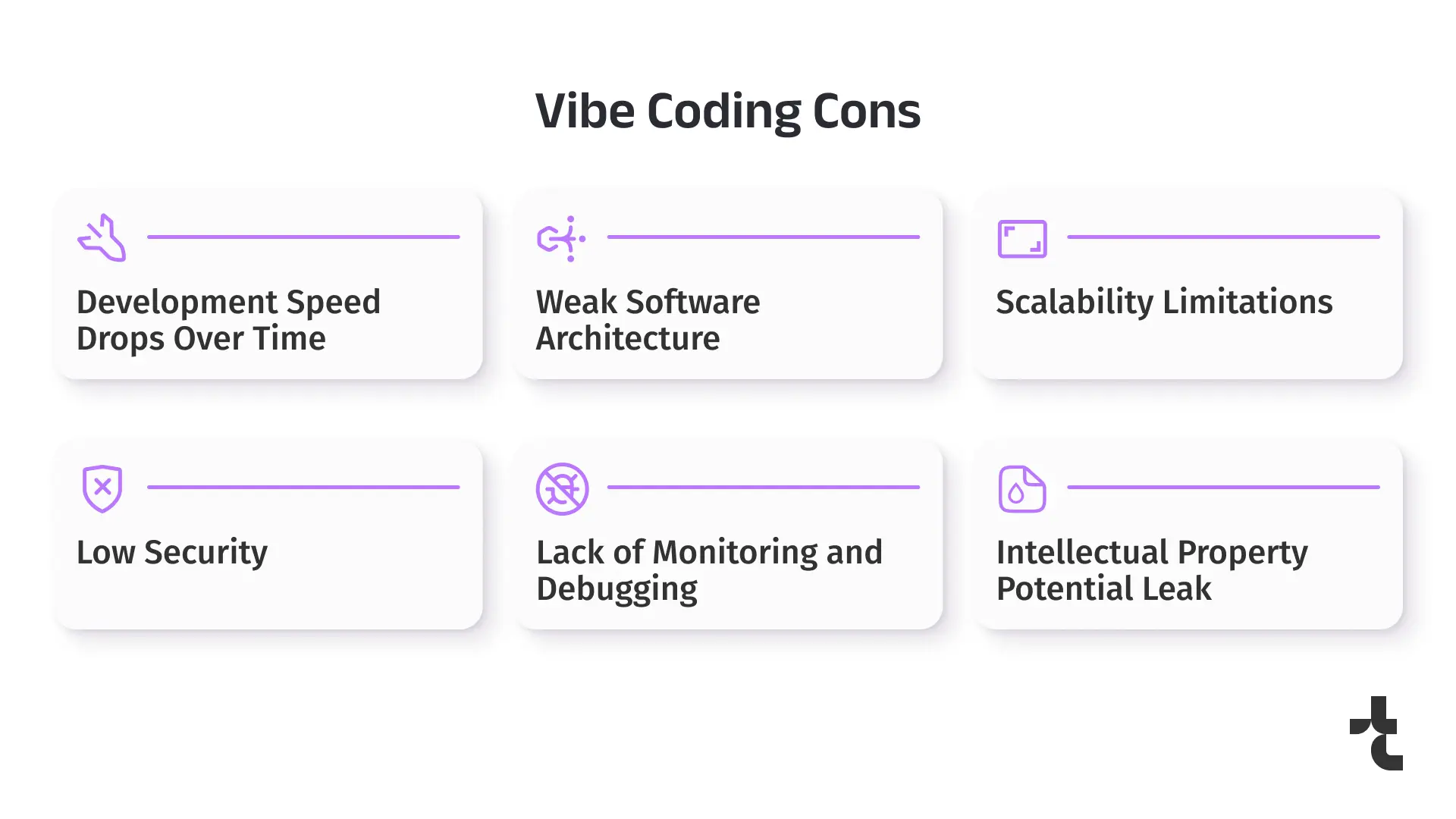
- The biggest surprise is how speed drops over time. You can generate a prototype in days, but small edits later become expensive and frustrating. The system may not follow instructions precisely — or worse, change things you didn’t ask for. This is where the risks of AI-generated code show up: unclear prompts, unpredictable outputs, and fragile structure make even simple fixes (like changing a UI layout or a header font) harder than expected.
- Another issue is weak architecture. Many apps look fine on the surface but are unstable underneath. This reflects the broader impact of ai on software development — faster creation, but not always better foundations. As a result, changes stack up as quick fixes instead of clean improvements.
- And here we face scalability limitations. Your app might work for 10 users, but handling real growth (up to thousands of users) is a different story. Many low-code ai platforms rely on fixed infrastructure, making it harder to scale or recover from failures.
- Security is a big concern. Web apps must meet standards like OWASP and GDPR, but many low-code and no-code tools don’t guarantee this level of protection. That opens the door to vulnerabilities, data leaks, and compliance risks.
- On top of that, many platforms lack mature tools for monitoring and debugging. When something breaks, it’s hard to trace errors or understand what went wrong.
- And finally, there are concerns around intellectual property. When you share ideas with AI systems, parts of your logic or product vision may be reused to train other models, which creates risks for your uniqueness.
In short, vibe coding is great for starting — but turning it into a reliable product is a different challenge.
So, Is Vibe Coding Useless?
Of course not. One of the clearest wins is rapid prototyping with AI. Instead of spending weeks planning everything on paper or polishing Figma screens, you can quickly spin up something clickable and real simply by using your creativity.
When does the vibe coding concept really matter?
1. First, it’s a powerful tool for fundraising. A working app prototype can go beyond static mockups in a pitch deck and even Figma click-through flows, offering a more realistic experience. This makes pitch MVP with AI far more convincing — investors don’t just hear your idea, they can actually interact with it. It’s a major upgrade for prototyping for investors, especially at early stages.
2. Second, it’s perfect for validation. You can test your idea with a small group of users and see what sticks. Early users don’t expect perfection, so they tolerate rough edges and help you quickly find what matters. That’s where the real benefits of vibe coding show up — fast feedback loops with almost zero setup friction.
3. Third, it’s a smart way to test market timing. If your idea is fresh, a quick prototype helps you “claim space” and start conversations early. Just keep in mind — real products still require proper security, compliance, and scaling.
4. And finally, prototypes like this often become your first real spec. Instead of long docs, you get a working flow that makes the logic and gaps clearer.
That’s one of the key advantages of vibe coding — turning ideas into something tangible fast enough for teams to react, not just discuss.
From Vibe to Viable: Can AI Prototypes Become Real Products?
It feels like a shame to simply throw away a product created with vibe coding platforms. Using it only as a prototype often underestimates its real value. So the question is: can we actually fix the problems in the codebase, architecture, and security, and turn it into a production-ready application?
We often get this request at Timspark. And the good news is — in most cases, the answer is yes: we can improve your vibe-coded app and put it on a professional footing. But what does it take?
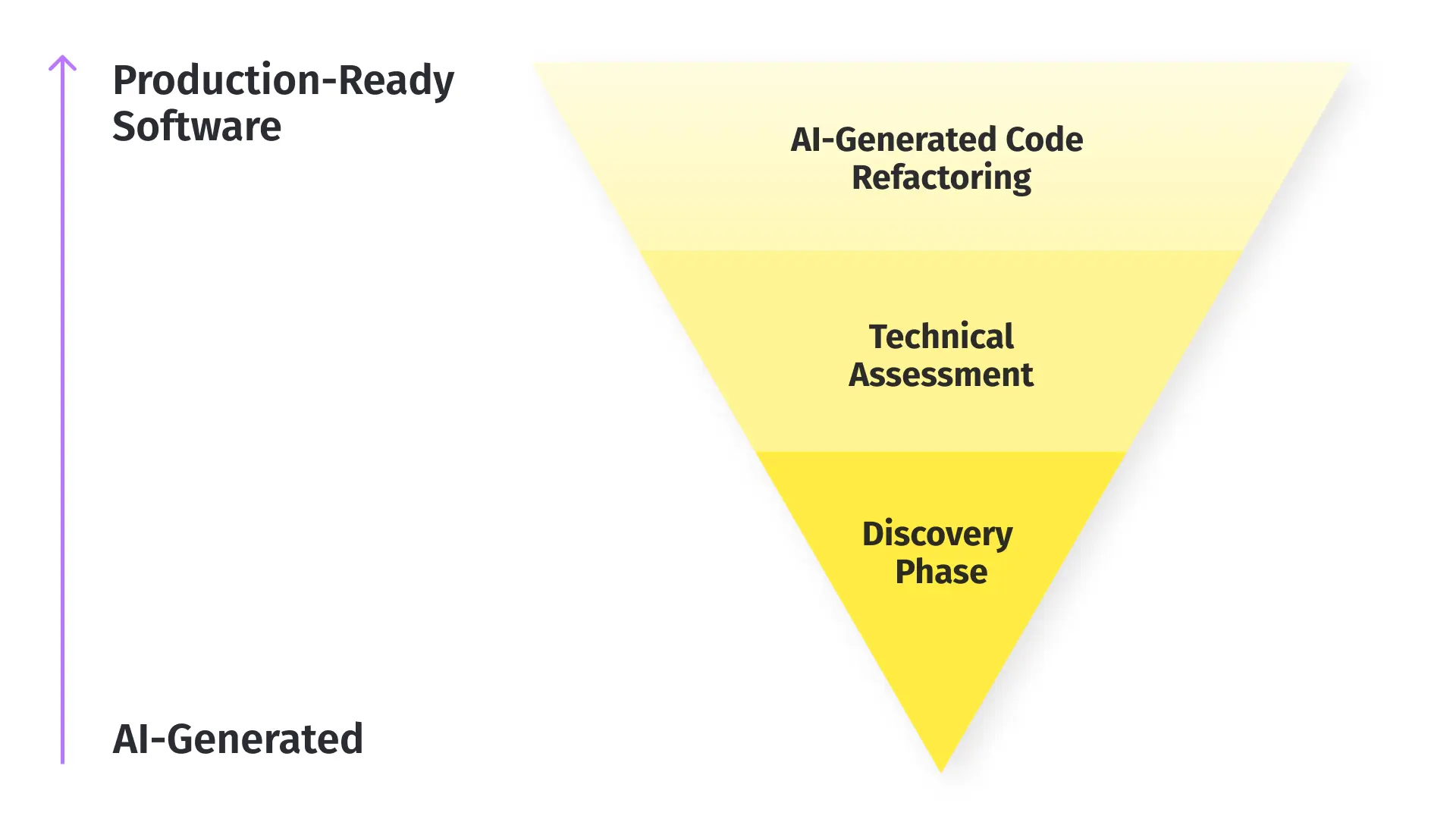
First, we need to understand the scale of the problem. During a short discovery phase (1–2 weeks), our system analysts clarify what your product is supposed to do and who it is built for. At this stage, we focus heavily on non-functional requirements: expected number of users, target markets, legal restrictions on certain cloud technologies (for example, in China), compliance requirements like GDPR in the EU or HIPAA for healthcare, required integrations, as well as constraints such as budget and timelines.
Next, a software architect performs a technical assessment. This senior specialist evaluates architecture, data models, security from an OWASP perspective, and overall code quality, including technical debt. The result of this phase is a structured report outlining what can be kept, what must be fixed, and what should potentially be migrated to a different tech stack. It also includes a list of issues and a recommended project roadmap.
After that, specialized engineers step in — you could call them vibe code refactoring engineers or AI code cleanup developers. These are programmers who gradually transform your prototype into a stable, production-ready system. They refactor AI-generated code step by step, improve architecture, strengthen security, and align the product with real-world scalability and performance requirements.
In addition, this phase often includes setting up proper logging, monitoring, and deployment pipelines — because without these fundamentals, even a good AI-generated idea cannot survive in production.
In the end, the goal is not to discard what was built, but to evolve it. A vibe-coded prototype can absolutely become a strong foundation for a real product — it just needs engineering discipline, structure, and the right level of refinement.
AI Assisted Software Development in Action
To wrap things up, it’s worth looking at how AI trends are actually used in professional engineering teams.
Experienced developers also use vibe coding in a way — or more accurately, AI assisted software development — but in a much more controlled and precise way. Instead of “just build me an app”, they give the AI small, well-defined tasks and use it like a smart pair programmer.
A big win is the automation of boring stuff. Testing, debugging, writing docs, finding edge-case bugs — all of this is now heavily supported by tools powered by AI in software development. It saves time, reduces costs, and helps teams ship faster without burning out.
Modern IDEs also come with built-in AI agents that understand project context. That’s basically where AI coding trends are heading — tighter integration, less guessing, more context-aware assistance, and fewer random hallucinations compared to early tools.
But here’s the catch: AI is still not fully reliable. It can suggest outdated patterns, deprecated libraries, or “technically correct but risky” solutions. That’s why professional engineers are still essential — someone has to validate, adjust, and sometimes completely reject AI suggestions.
This is where AI-driven development actually lands in real life: not replacing developers, but making them faster, more focused, and more strategic. The AI writes drafts — humans take responsibility for architecture, quality, and final decisions.
The Bottom Line
So you’ve got an AI prototype for investors, and now it’s time to fix the technical issues and take your product to the next level. That’s where we come in.
At Timspark, we help you bridge the gap between fast AI creation and real-world production. From a deep technical audit of your codebase to complete software stabilization and deployment, we ensure your idea doesn’t end up gathering dust on a shelf among countless other ideas.
Although you may face technical obstacles, especially around scalability, security, and architecture, it doesn’t mean you have to lose the benefits of vibe coding from the early stages. We help you keep the momentum, fix what needs fixing, and turn your AI-built prototype into a reliable, production-ready application that can actually scale.
Let’s turn your vibe into something real!
References
- The Vibe Coding Delusion: Why Thousands of Startups Are Now Paying the Price for AI-Generated Technical Debt. TechStartups, 2025.