
Does Your Business Need a Mobile App in 2026?

March 9, 2026
In 2026, the mobile landscape has matured significantly. We’ve moved past the “gold rush” era where simply having an app was considered a win. Today, an app is a sophisticated business engine that either drives measurable growth or becomes a mounting source of technical debt. In fact, many businesses are treating mobile as a selective investment in 2026—not a default. A recent TechBehemoths survey found that most respondents rate mobile apps as a low priority, and many plan to stay web?only or remain in evaluation mode.
At Timspark, we’ve observed that the most successful projects don’t start with code; they start with a rigorous alignment of technology to business outcomes.
Start With One Business Goal (Not the Platform)
The most common point of failure in mobile development isn’t a bug in the code – it’s a lack of focus. Many leaders approach us asking whether they should build in Flutter or Swift before they’ve identified the core metric the app is intended to move. To ensure genuine ROI, you must treat your app as a tool for “Metric-Driven Development. This KPI discipline is also the fastest cure for ROI ambiguity: in the same survey, a large share of respondents reported having no clear ROI expectations for mobile apps. If you can’t name the metric, you can’t defend the investment—or iterate toward results.“
If your primary challenge is customer loyalty, your focus should be on Retention and Engagement, measured through push notification opt-in rates and churn reduction. It’s worth noting that teams don’t pursue mobile for one reason: survey respondents most often tied mobile apps to growth outcomes (acquisition and revenue), with internal efficiency and retention following behind. That’s another reason to pick one KPI up front—so ‘important’ doesn’t become ‘everything.’ We’ve previously explored how specific technical features can directly impact
If you are looking for direct growth, the architecture must prioritize Revenue Metrics like subscription retention and average revenue per user (ARPU). For enterprise-level tools, the goal is often Internal Efficiency, where the app’s success is measured by the number of hours saved or the number of human errors eliminated. Without one of these KPIs, your technology choices will lack direction, and your ROI will remain uncertain.
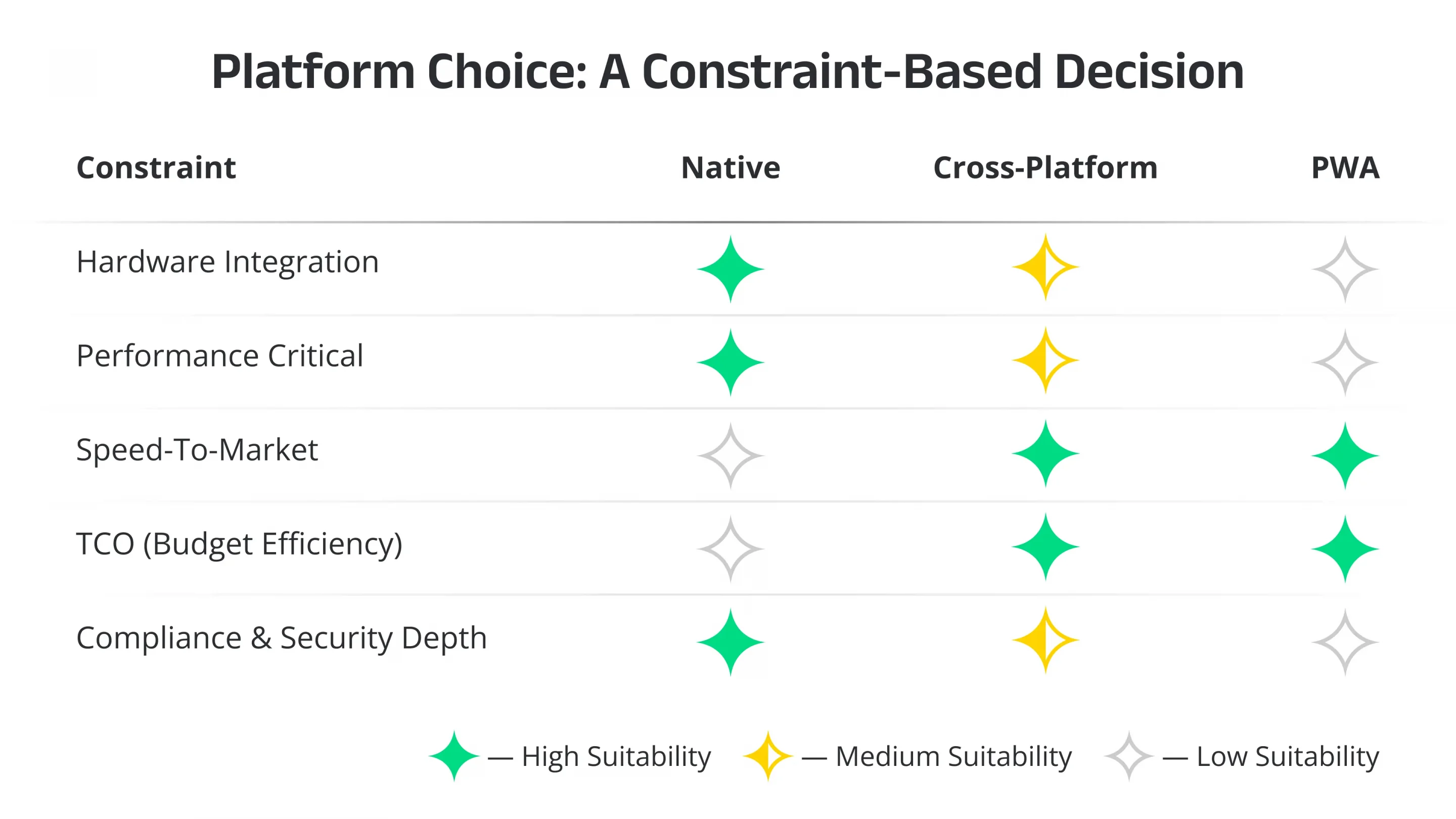
Platform Choice: A Constraint-Based Decision
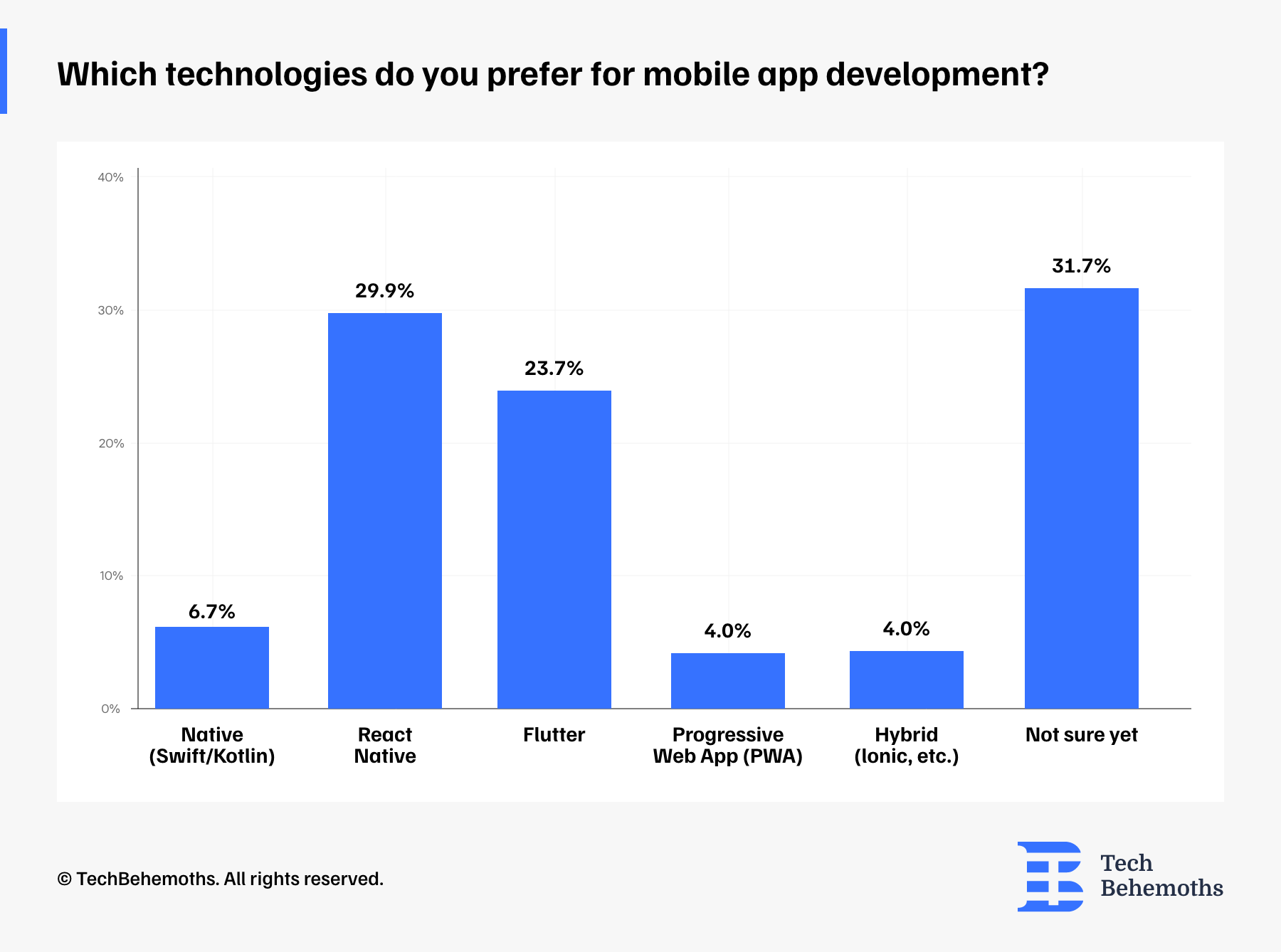
The long-standing debate between native and cross-platform development has shifted. In 2026, it is no longer about which technology is “better,” but which one fits your specific business constraints. That shift shows up in what teams prefer: respondents leaned heavily toward cross?platform frameworks (React Native and Flutter), and a sizeable group said they’re still unsure—meaning the ‘right’ answer is often a decision framework, not a tool pick.
Native development remains the gold standard for apps that require deep device integration. If your roadmap includes complex camera pipelines, background processing, or high-security biometrics, Swift or Kotlin is the logical choice. This path is also essential for brands that make premium, high-performance UX a core differentiator, or for those operating in highly regulated industries where security is non-negotiable.
While native apps offer the deepest integration, the choice often comes down to the fundamental trade-offs explored in our comparison of
Conversely, Cross-Platform frameworks like Flutter or React Native are the strategic choice when speed-to-market and budget efficiency are paramount. This approach allows you to maintain a single codebase for both iOS and Android, which is ideal when your product scope is still evolving and you need to iterate quickly based on user feedback. Cross-platform frameworks offer great efficiency, though they are not without friction. Navigating specific
Finally, Progressive Web Apps (PWAs) can be a smart lightweight option when your experience is largely web?based and distribution speed matters more than deep OS integration. In practice, PWAs show up as a smaller share of preferences—and some teams even consider replacing an app with a PWA—so the best use case is a web?first product that still benefits from an ‘app?like’ shell.
AI in 2026: From Hype to Execution
AI is no longer a ‘future’ feature – it is a baseline expectation. According to the survey, AI integration was the most-cited trend expected to influence mobile decisions. For enterprise-scale applications, understanding the broader
1. Deployment Location: You must decide between Edge AI (On-Device) and Cloud-Based AI. On-device processing is the superior choice for privacy-sensitive tasks such as health tracking or biometric authentication because it operates offline and keeps data local. Cloud-based AI is reserved for “heavy lifting” tasks like Large Language Models, which offer more power but require a robust data-protection strategy to manage the constant flow of information between the device and your servers.
2. Compliance and Utility: Treat AI as a data feature with a UX. App stores increasingly scrutinize how apps collect, use, and share data—especially when third?party services are involved—so your AI flows should be explicit about what’s happening and why. Also, run the Utility Test: if the AI doesn’t save meaningful time (e.g., faster triage, smarter search, less manual data entry), it’s likely adding complexity without moving your KPI. This matters operationally, too: survey respondents still cited app store approvals and security as real (even if less frequent) delivery constraints.
Budgeting for the Entire Lifecycle
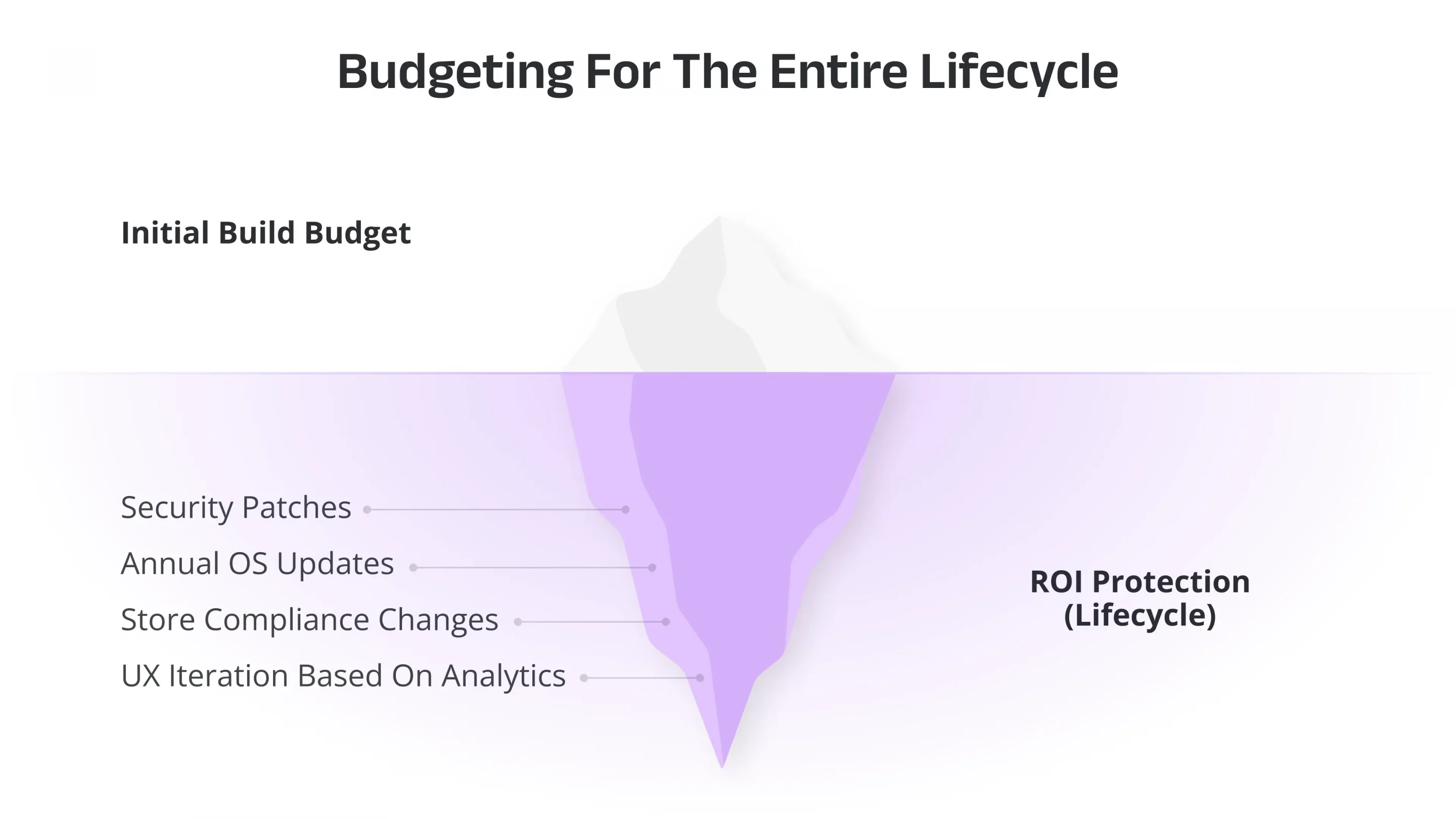
A significant blind spot is conflating the ‘Build Budget’ with the ‘Total Investment.’ The survey data explain why this blind spot is common: most respondents who budgeted for mobile expected a relatively modest spend for build and first-year maintenance, and many didn’t estimate a budget at all because they have no app today. That gap is where ROI gets vague—and where maintenance becomes a surprise line item.
While the initial
1. OS Updates: iOS and Android ship major releases annually, and changes in permissions, APIs, and device behavior can force updates—especially if your app relies on older dependencies.
2. Security Patches: Protecting user data is a continuous process, not a one-time setup.
3. Store Compliance: Requirements for privacy manifests and data safety labels change frequently.
4. UX Iteration: Your first version is a hypothesis; your second version is where the real ROI happens based on user analytics.
At Timspark, we view maintenance not as a hidden cost, but as ROI protection. That framing matches what teams struggle with in practice: beyond build cost, respondents cited ongoing maintenance—and the downstream impact on adoption and ROI—as recurring challenges. An unmaintained app is a declining asset that will eventually lose its place on a user’s home screen. To manage this effectively, we rely on
Success in Regulated Environments
In industries such as healthcare, a mobile strategy must balance exceptional user experience with uncompromising compliance. This is also why ‘Does your business need an app?’ is industry-dependent. In the TechBehemoths survey, more than half of respondents said mobile apps should be recommended mainly for specific industries—healthcare being a clear example where security, auditability, and reliability are gating requirements, not differentiators.
For organizations operating in highly regulated environments, success depends on secure, outcome-focused architectures that integrate seamlessly into broader SaaS ecosystems.
This level of rigor – prioritizing secure access, structured data, and architectural clarity – is what Timspark brings to every project, regardless of the business domain.
Choosing the Right Strategic Partner
Mobile development is a long-term commitment. In 2026, the right partner is one who looks beyond the MVP and understands the complexities of the modern mobile ecosystem. The strongest signal to look for is proof, not promises: survey respondents ranked proven experience as the #1 factor when choosing a mobile development partner, followed by reputation and industry expertise—well ahead of cost. When evaluating a potential collaborator, look for a partner with a transparent delivery process that includes specialized
-
- Proven experience in handling similar technical or regulatory complexity.
- A transparent delivery process that includes robust QA and automated release management.
- A commitment to ownership, ensuring you retain full control of your documentation and code.
At Timspark, our approach to custom mobile development and consulting is designed to turn your mobile presence into a strategic asset that grows with your business.