

U

From Prototype to Production: Why Software Delivery Still Fails

From Prototype to Production:

Why Software Delivery Still Fails

LAST UPDATED:

TIMSPARK RESEARCH SERIES – PART 2 OF 2

Qualitative research based on 20 interviews with technology and business leaders across Europe and international markets.

How to read this research

Timspark Innovators interviews are the primary qualitative evidence. Gartner sources are used for analyst forecasts and survey-based comparison. Forbes sources are used as indicators of wider executive and technology commentary, not as equivalent statistical evidence. Apparent contradictions are retained where they reveal differences by industry, company maturity, risk level or geography.
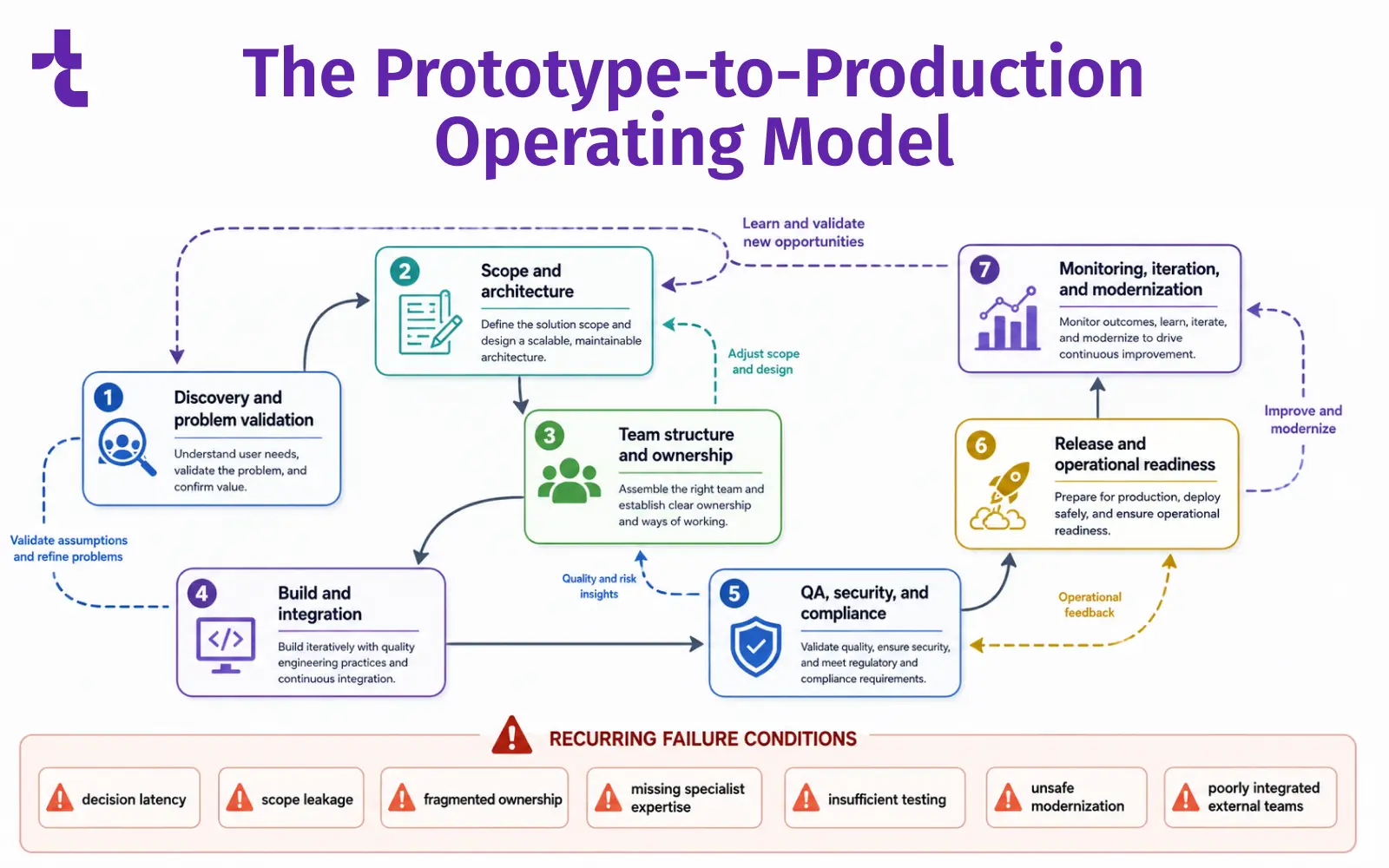
Prototype-to-production operating model showing discovery, architecture, team ownership, build, QA, release, monitoring, feedback loops, and recurring software delivery failure conditions.

Research question and executive findings

Why do technically capable teams still struggle to ship, scale, and sustain software products? The interviews show that the persistent delivery problem is not a lack of tools. It is the difficulty of aligning scope, decisions, specialist talent, users, quality, regulation, and external partners around one operating model.

      • Delivery slows when decisions, feedback, and access move more slowly than engineering.
      • A prototype becomes a product only after industry-specific risks and workflows are addressed.
      • The market needs broad ownership and deep specialization at the same time; the solution is a composable team rather than a universal individual.
      • External teams create value when they add governed capability, not when they are treated as inexpensive headcount.
      • Modernization fails when organizations select a destination before understanding architecture, cost, people, and workflow.
      • Remote work reduces geographic constraints but does not remove the value of proximity, shared context, and regional trust.

Software delivery is an organizational system. Engineering velocity is only one of its variables. AI introduces another layer to this system. Part One examines the data, governance, privacy, and human judgment behind enterprise AI readiness.

Methodology and limitations

Part Two uses the same 20-interview qualitative corpus, with greater emphasis on delivery, product readiness, modernization, team design, and sourcing models. The analysis aggregates evidence by operating problem and industry rather than attributing conclusions to individual interviewees. Industry differences are retained because an effective model for a small creative studio may be unsafe for a medical platform, inefficient for a regulated bank, or too rigid for an early-stage product company. The research identifies patterns and contradictions; it is not a statistically representative survey.

FINDING 1

The real cost of speed is scope and decision latency

Teams often lose more time to unclear decisions and expanding commitments than to technical execution.

FINDING 2

Production readiness is defined by the industry

The same technical prototype faces different thresholds in games, healthcare, agriculture, mobility, finance, and HR technology.

FINDING 3

The specialist-generalist contradiction

Lean teams need broad ownership; high-risk systems need deep specialization. Both statements can be true.

FINDING 4

What should remain in-house?

Strategic context, architecture, and accountability tend to stay close; scarce and variable capabilities are more open to external partnership.

FINDING 5

Modernization begins with diagnosis

Replacing old technology without understanding workflows, people, costs, and risk can make the organization less capable.


FINDING 6

Geography still shapes delivery

Remote work expands the talent market, but regulation, time zones, localization, and trust continue to affect the practical value of a partner.

Topic

Interview finding

Gartner signal

Forbes signal

Engineering teams

Smaller teams work only when they retain access to specialist depth.

AI-native platforms will make teams smaller and more nimble.

Role convergence and T/E-shaped skills will increase.

Modernization

Diagnosis and operating capacity matter more than fashionable architecture.

Cloud dissatisfaction rises with poor strategy and uncontrolled cost.

Model and tool choice should follow use case and risk.

External partners

Capability, integration, and governance matter more than cheap headcount.

Sovereignty and regional context increasingly influence provider selection.

Executive narrative increasingly emphasizes practical value over hype.

Production readiness

Industry risk and workflow define release readiness.

Agent projects fail when value and controls are unclear.

Agent adoption is expected to accelerate, but barriers remain.

Seven-stage prototype-to-production operating model from discovery through release and modernization, with feedback loops and recurring risks including scope leakage, decision latency, fragmented ownership, and insufficient testing.

1. The real cost of speed is scope and decision latency

The interview corpus challenges the assumption that engineering velocity is the main determinant of delivery speed. Projects often slow because approvals, feedback, system access, and scope decisions move more slowly than implementation. The visible delay appears in engineering, but the cause sits in the wider organization.

Decision latency creates several forms of waste at once. Engineers wait, switch context, or proceed on assumptions. Work that was technically correct may need to be revised after late feedback. Delivery forecasts become unreliable because cycle-time metrics capture active development but not the time spent waiting for a decision owner.

Scope leakage produces a related problem. Fast delivery can create momentum and invite additional requests, but each addition consumes design, implementation, testing, documentation, and operational capacity. In small creative teams, one feature can become a system that prevents release. In enterprise projects, apparently modest additions can create technical debt and team fatigue.

Public-sector contracts intensify the issue because specifications are often written before implementation reveals the full operational detail. Requirements become clearer during delivery, while the budget and deadline remain fixed. Teams then have to distinguish essential functionality from lower-value additions and reprioritize without compromising the public outcome.

The strongest counterexample in the corpus is disciplined expectation management. When capacity, scope, and time-zone constraints are made explicit early, teams can protect a sustainable rhythm and avoid treating overtime as a normal delivery mechanism.

The common lesson is that cycle time should include waiting, access, approval, scope additions, and rework. AI can accelerate artifact creation, but it cannot compensate indefinitely for an organization that cannot decide.

2. Production readiness is defined by the industry

A working prototype proves that an idea is technically possible. Production readiness proves that the complete product can operate within the risk, workflow, commercial, and trust conditions of its industry. The interviews show that these conditions vary substantially.

In games and interactive products, readiness includes onboarding, UI clarity, performance, QA, localization, certification, and market visibility. A static concept can look excellent and still fail inside a real user flow. The practical implications can be compared with Timspark’s Unity mobile game development case, where external specialists were integrated into an existing creative and engineering workflow.

In healthcare, the threshold is much higher. Secure data, accessibility, clinical impact, quality-management procedures, supplier controls, code review, multiple test environments, reimbursement and regulatory documentation may matter more than feature velocity. A design that works for a consumer application may be unusable for an elderly patient or unacceptable in a clinical workflow.

The complexity is visible in a 3D medical imaging software project that combined machine learning, medical data formats, secure storage, backend engineering, QA, and clinician-facing tools. The value came from the integrated system and workflow, not from one technical component.

In agriculture, a product has to survive physical conditions. Hardware, connectivity, image capture, AI detection, microclimate data, and agronomic advice must work together outside a controlled pilot. In public mobility, readiness also includes citizen trust, fiscal rules, payment security, and operational scale. In HR technology, relevance, transparency, and a credible human process around the algorithm influence adoption.

These differences explain why QA outsourcing and software testing cannot be reduced to defect detection. Test strategy needs to reflect user behavior, integrations, performance, compliance, data risk, and the consequences of failure in the target sector.

Production readiness is therefore not a universal checklist. It is the point at which a product fits the operating reality and risk threshold of the environment in which it will be used.

3. The specialist–generalist contradiction

The corpus contains a real disagreement about team shape. Some lean software organizations need engineers who can work across front-end, back-end, databases, cloud, and business context. Regulated and safety-critical environments protect deeper specialization because errors carry greater consequences and formal role boundaries support quality.

The hardest roles are frequently hybrid rather than universal. Examples include technical UI designers who bridge engineering and visual systems, integration specialists who combine technical depth with partner communication, automation QA engineers who can both test critically and write code, and data or AI specialists who understand the industry in which the model operates.

This suggests that broad ownership and universal mastery should not be confused. Teams benefit when specialists understand adjacent areas and can share delivery responsibility. They become fragile when one person is expected to be an expert in every technology, domain, quality practice, and infrastructure layer.

The strongest operating pattern is the composable team: deep specialists, selected bridge roles, enough adjacent knowledge to reduce handover friction, and access to fractional expertise when the capability is important but not required full-time.

This model provides a more precise response to the global IT skills shortage. The shortage is not simply a lack of developers. It is a shortage of senior judgment and combinations of skills that are difficult to produce through rapid reskilling.

Gartner expects AI-native platforms to support smaller, more adaptable engineering teams. Forbes and Forrester commentary similarly anticipate role convergence and T- or E-shaped profiles. The interview evidence adds a qualification: smaller teams still need dependable access to deep expertise, even when it is not permanent or full-time. [G1] [G4] [F1]

4. What should remain in-house?

The research does not support a general movement either toward or away from outsourcing. It shows a more selective division between strategic core knowledge, permanent operational capability, variable capacity, and scarce specialist input.

Companies tend to retain architecture, business logic, sensitive integrations, compliance ownership, and the knowledge that differentiates the product. They use external partners for specialist expertise, temporary demand, independent workstreams, or capabilities that would be inefficient to hire permanently.

This is the strongest use case for Rozszerzanie zespołu IT: bridging a specific capability gap while the client retains product ownership and governance. The model is weaker when it is treated only as inexpensive headcount or when external specialists operate outside the client’s delivery and quality system.

Longer-term products may require a dedicated development team that shares roadmap responsibility, communication cadence, and quality expectations. The distinction is not the employment label; it is the level of ownership and integration required.

The corpus also supports fractional models. A compact product team may need senior DevOps, architecture, security, data, or QA expertise for a limited number of hours rather than as a full-time role. This can preserve specialist quality without adding fixed capacity that the product cannot use consistently.

External relationships work best when problems are disclosed early, responsibilities and decision rights are explicit, and contractors use the same onboarding, code review, documentation, and delivery controls as internal engineers. A partner should add governed capability rather than create a new coordination layer.

The sourcing decision can be supported by an educational guide to staff augmentation, but the final classification should be made capability by capability: strategic core, permanent operation, variable capacity, or scarce specialist input.

5. Modernization begins with diagnosis

The interviews repeatedly reject modernization strategies that begin with a predetermined cloud provider, framework, or complete rewrite. Old systems contain integrations, business rules, user habits, and organizational knowledge that may not be documented elsewhere.

A structured project discovery and technical assessment should examine architecture, dependencies, usability, test coverage, security, data, operating cost, and the capabilities of the team that will maintain the target system.

The organization can then make a portfolio of decisions: retain stable components, refactor constrained layers, isolate high-risk dependencies, migrate suitable workloads, and replace only what no longer supports the business. A technically modern stack can still be the wrong destination if the team cannot operate it or if the transition destroys valuable knowledge.

Cloud transformation should be tied to measurable outcomes through cloud migration consulting services: performance, resilience, security, cost control, scalability, or faster delivery. Changing the vendor name on the infrastructure is not by itself modernization.

The same principle applies to delivery infrastructure. DevOps consulting services can improve CI/CD, infrastructure as code, monitoring, environment management, and operational ownership, but the tools should follow the assessed bottleneck rather than lead the transformation.

Modernization should also be connected to a plan for reducing technical debt with DevOps. Technical debt becomes economically relevant when it slows changes, raises incident risk, prevents integration, or makes the system too expensive to understand and operate.

Open-source tools and frameworks require the same contextual assessment. They can be appropriate for startups and standard use cases, but enterprise or regulated products need to consider maintenance, community health, security updates, deprecation risk, and the cost of replacing a dependency later.

Gartner predicts increasing cloud dissatisfaction where expectations are unrealistic, implementations are weak, or cost is uncontrolled. The corpus supports a practical response: modernization is an operating-model decision supported by technology—not a technology purchase that automatically changes the operating model. [G6]

5. Geography still shapes delivery

Remote work has expanded access to talent and enabled international delivery, but the interviews do not support the idea that geography has become irrelevant. Different work requires different degrees of synchronous communication, cultural context, time-zone overlap, and physical proximity.

Execution with stable requirements can work effectively across distributed teams when documentation and decision outcomes are visible. Creative discovery, crisis response, trust-building, and the early stages of product definition may benefit from more synchronous or in-person interaction. Leadership also loses some informal signals when all communication is mediated by scheduled calls and written tools.

European proximity can create practical value through working-hour overlap, regulatory familiarity, multilingual capability, and easier integration with customer organizations. This is a stronger proposition than labor cost alone, particularly in financial services, healthcare, public infrastructure, and other regulated sectors.

Localization adds another geographic layer. It is not only translation. Products may need to account for regional language variants, reading patterns, data conventions, payment expectations, platform certification, accessibility, and the way local institutions structure the customer journey.

The European market also presents a scale problem. Companies can be technically strong while repeatedly adapting certification, reimbursement, language, and commercialization processes across national borders. By contrast, major U.S. ecosystems concentrate customers, investors, technical talent, and rapid market feedback in the same geography.

The breadth of delivery contexts represented in Timspark’s software project portfolio shows why sourcing and product decisions should be matched to industry, risk, and geography rather than reduced to a single global operating model.

Gartner’s sovereign-cloud and region-specific AI forecasts indicate that infrastructure and vendor geography may become more important even as collaboration remains remote. European providers can use sovereignty, regulation, specialization, and proximity as differentiators, but they need globally competitive product and delivery discipline. [G5] [G8]

From analyst forecasts to operational reality

Where the findings align

The corpus supports Gartner’s view that AI-native development will change team structures, that cloud value depends on governance and realistic expectations, and that sovereignty will influence vendor selection. It also supports Forbes and Forrester commentary on role convergence and the movement of human work toward orchestration and systems thinking.

Where the narrative is too simple

Global discussions often imply that faster coding leads directly to faster delivery. The interviews show that scope, decision latency, stakeholder access, quality obligations, and market readiness frequently dominate cycle time. Coding acceleration can expose these organizational constraints rather than remove them.

Where operating models legitimately conflict

Some companies need broad generalists; others need protected specialist tracks. Some prioritize in-house cohesion; others rely on fractional partners. Remote work improves retention in one environment and weakens creative collaboration or leadership visibility in another. These are not inconsistencies to eliminate. They are evidence that operating-model choices need to follow product risk, scale, and work type.

Research implications

  1. Measure decision latency, waiting time, scope additions, and rework alongside engineering throughput.
  2. Define production-readiness criteria by industry before approving a pilot or MVP roadmap.
  3. Build composable teams with specialist depth, bridge roles, adjacent knowledge, and fractional expertise.
  4. Classify capabilities as strategic core, permanent operation, variable capacity, or scarce specialist input before sourcing.
  5. Require external teams to share the delivery and quality system rather than operate as a disconnected task queue.
  6. Begin modernization with architecture, workflow, risk, cost, data, and skills assessment—not a predetermined platform.
  7. Match remote, hybrid, and in-person collaboration to the work being performed.
  8. Position European delivery through regulatory knowledge, proximity, specialization, and trust rather than cost alone.

Conclusion

The persistent software-delivery problem is not a shortage of tools. It is the difficulty of aligning scope, decisions, talent, users, quality, regulation, legacy systems, and partners around one operating model. Organizations facing this complexity may use custom software development services to combine discovery, architecture, engineering, QA, DevOps and product ownership within one governed delivery system.

The path from prototype to production is not a technology handoff. It is an organizational alignment problem.

References

Behind the Hype of Vibe Coding: Turning Ideas Into Dream Products

Behind the Hype of Vibe Coding: Turning Ideas Into Dream Products

Last updated:

Over the past few years, we’ve entered a new era where AI isn’t a “nice-to-have” anymore — it’s the default. Almost every new software startup now involves artificial intelligence in some form. With vibe coding, it looks almost magical — you describe what you want, give AI a direction, and boom: a working product appears. No deep tech skills, no long dev cycles. Just ideas turning into apps in hours.

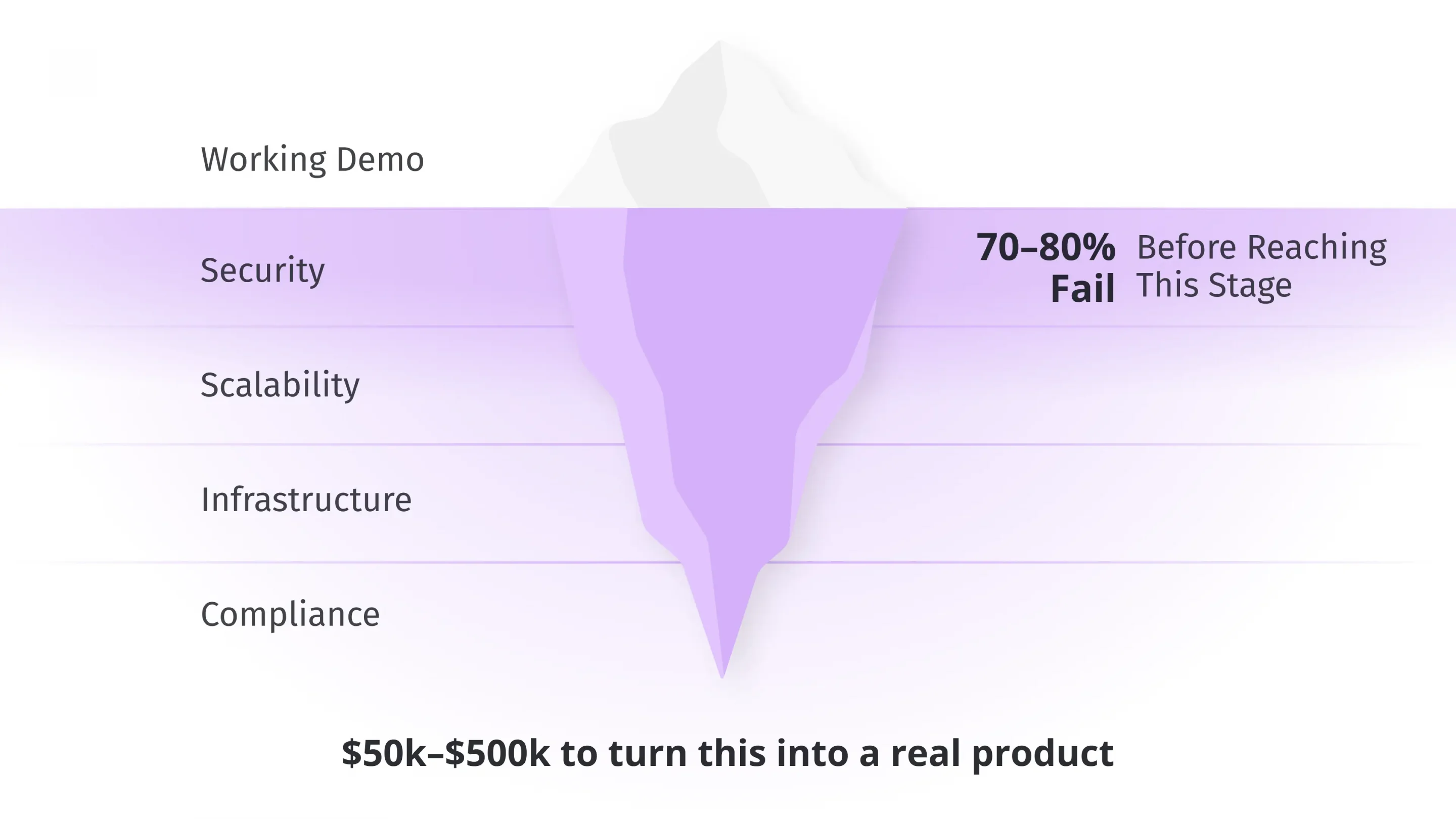
But once the entry barrier dropped, the success rate didn’t magically improve. According to industry estimates, up to 70–80% of AI-built startups fail, and turning a “working demo” into a secure, scalable product often requires serious engineering effort with budgets ranging from $50K to $500K.

Bar chart showing 2024 H-1B visa approvals by top tech employers: Amazon Services LLC leading with 10,044 approvals, followed by TCS, Microsoft, Meta, Apple, Google and Cognizant, illustrating how US visa demand concentrates in a few large software companies.

So what’s really going on, and where do AI coding tools actually shine? Let’s break it down together with Timspark.

Vibe Coding: The Idea in a Nutshell

What is vibe coding? It is a new way of building software where you don’t write everything line by line — you guide no-code tools with intent instead. No more strict specs, you just speak to AI, providing the “vibe” of your future product, and your smart assistant turns it into working features.

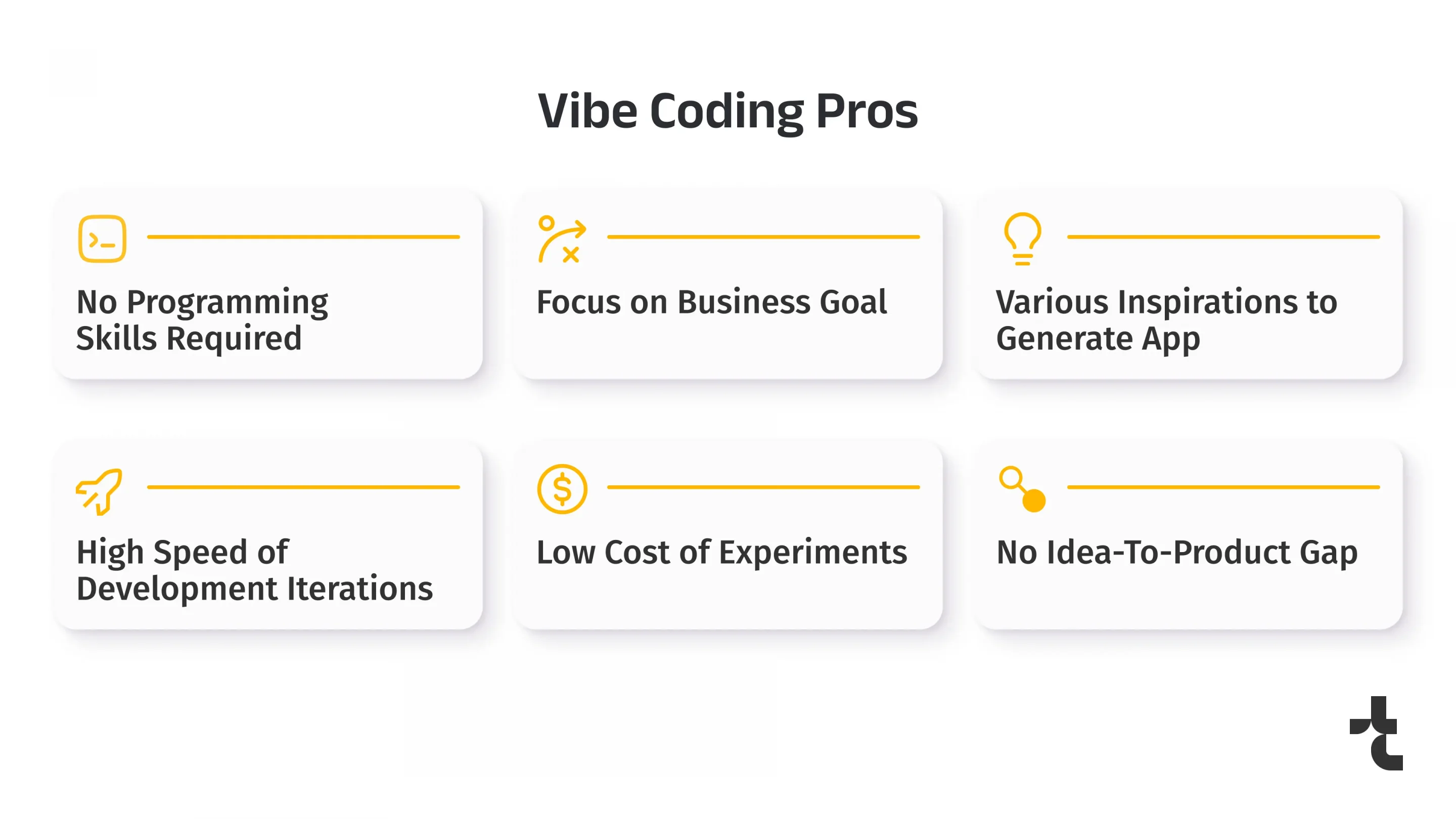
Sounds great — and it really is. The most obvious pros are clear:

    • You don’t need programming skills, which for many founders is a huge unlock, especially in a world where tech stacks evolve faster than people can keep up.
    • You stop obsessing over technical implementation and focus on the business itself: what your “Silicon Valley dream” software should do, who it is for, and what actually makes it stand out.
    • AI coding tools can work with much richer input than traditional dev processes — you can feed them inspirations like color palettes, screenshots, slogans, or even reference products to shape the direction of your idea.
    • You get extreme speed of iteration, testing multiple versions of the same idea in hours instead of weeks.
    • The cost of experimentation becomes dramatically lower, since you don’t need a full dev team or heavy infrastructure just to validate a direction.
    • You compress the idea-to-product gap, going from thought to working prototype almost instantly, which often unlocks more creativity and bolder thinking.
Bar chart showing 2024 H-1B visa approvals by top tech employers: Amazon Services LLC leading with 10,044 approvals, followed by TCS, Microsoft, Meta, Apple, Google and Cognizant, illustrating how US visa demand concentrates in a few large software companies.

Thus, it is less about writing code and more about designing the “feel” of your next big thing — and maybe hoping the AI didn’t take it too literally!


Top 5 Low-Code Platforms for Vibe-Driven Development

But what exactly are the best no-code solutions for non-tech creators? We won’t dive into well-known AI tools like Cursor, Claude, Windsurf, or Gemini here — while powerful, they are often used within development workflows or require some technical setup. Instead, we’ll focus on more business-friendly low-code and AI building platforms that run in the cloud, offer flexible plans or usage credits, and are designed to turn ideas into working applications quickly.

So here’s our top 5: Lovable, Base44, Wix Vibe, Bolt, and v0 by Vercel. You can compare them in the table below:

Criteria

Lovable

Base44

Wix Vibe

Bolt

v0 (Vercel)

What you can create

Full-stack web app (UI, backend, and database included).
Websites with built-in CMS, hosting, SEO tools, and analytics
Full-stack web apps & websites
Full-stack web apps (frontend-first, integration-based backend)

Easy to use

Easy

Moderate

Very easy

Challenging

Challenging

Target users

Non-technical users, founders, product teams
Startup builders (semi/non-technical)
Non-technical users
Semi-technical users
Both technical & non-technical users

Input method

Plain language + UI inspiration (UI prefs, references)
Plain language + limited visuals (screenshots/mockups)
Plain language + rich visual inputs (images, Figma, websites)
Plain language prompts + optional imported code
Plain language + existing codebases

Iterative refinement

Strong iterative refinement of features and requirements
Limited iterative refinement after initial generation (structured, constrained changes)
Strong iterative refinement through visual editing + prompts
Strong iterative refinement through prompts and manual code editing in a dev environment
Strong iterative refinement through prompt-based changes inside real codebases

Code access

Full access to codebase
Partial (frontend exportable)
No real code export
Full access. Provides a live coding workspace with file system, terminal, and real-time preview
Full access + GitHub integration

Hosting / lock-in

Low lock-in (exportable code, but initial infra is platform-managed)
Partial lock-in (backend & DB remain platform-dependent)
Strong lock-in (Wix ecosystem)
No lock-in
No lock-in

Pricing model

Credit-based (Free / Enterprise - price depends on company size and usage)

Credit-based (Free / Elite $160/mo)

Freemium (Light $17 / Business Elite $159/mo)

Token-based (Free / Enterprise - with custom quotes tailored to the team’s specific needs)

Credit-based (Free / Enterprise - pricing available based on organizational needs)

The Hidden Downsides of Vibe Coding

Using AI for software development feels like a cheat code at first — fast builds, instant results, zero friction. But once the hype fades, founders start hitting real problems with vibe coding. What felt like a sprint suddenly turns into a grind.

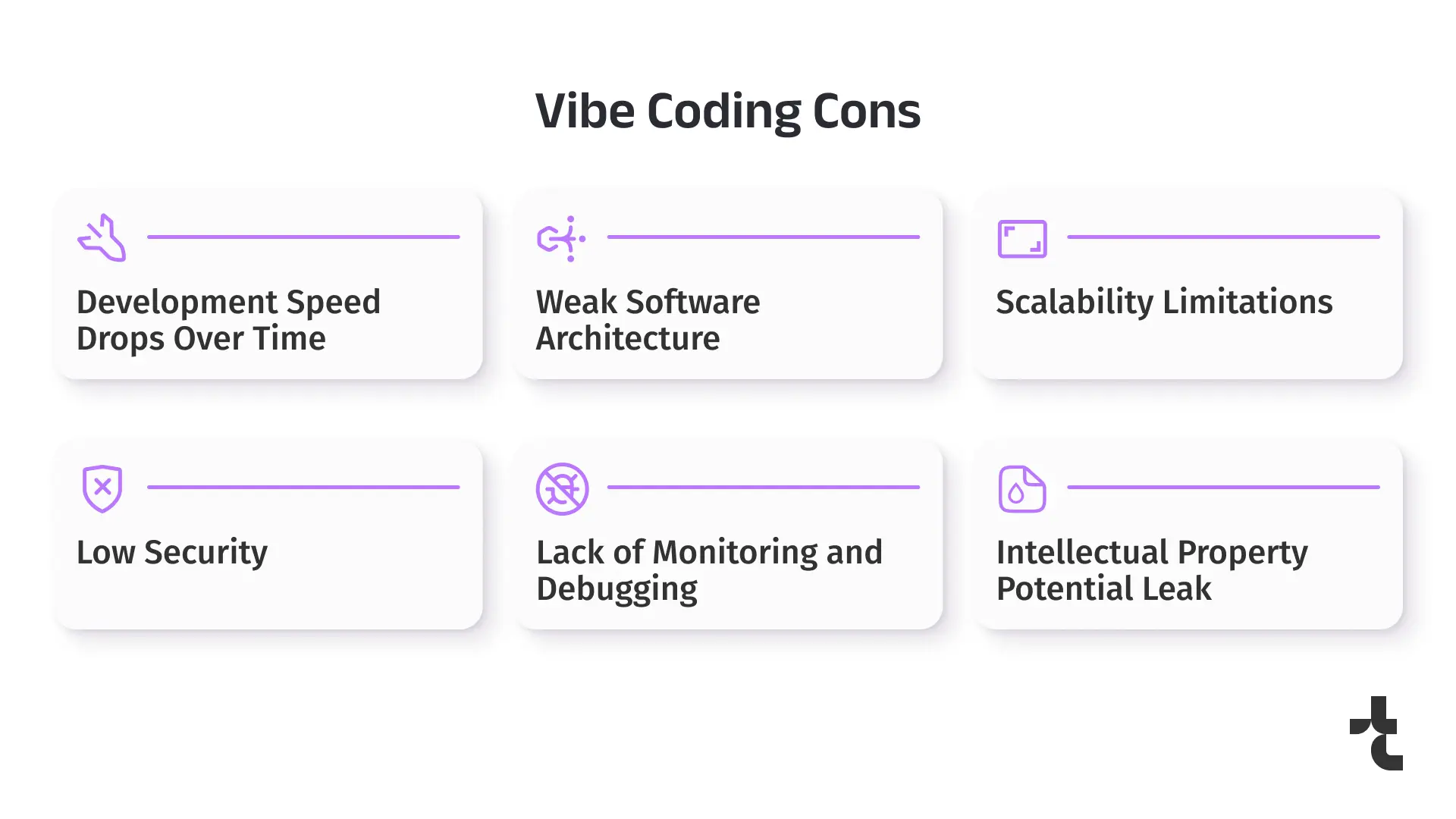
Let’s look at the key cons:


    • The biggest surprise is how speed drops over time. You can generate a prototype in days, but small edits later become expensive and frustrating. The system may not follow instructions precisely — or worse, change things you didn’t ask for. This is where the risks of AI-generated code show up: unclear prompts, unpredictable outputs, and fragile structure make even simple fixes (like changing a UI layout or a header font) harder than expected.
    • Another issue is weak architecture. Many apps look fine on the surface but are unstable underneath. This reflects the broader impact of ai on software development — faster creation, but not always better foundations. As a result, changes stack up as quick fixes instead of clean improvements.
    • And here we face scalability limitations. Your app might work for 10 users, but handling real growth (up to thousands of users) is a different story. Many low-code ai platforms rely on fixed infrastructure, making it harder to scale or recover from failures.
    • Bezpieczeństwo is a big concern. Web apps must meet standards like OWASP and GDPR, but many low-code and no-code tools don’t guarantee this level of protection. That opens the door to vulnerabilities, data leaks, and compliance risks.
    • On top of that, many platforms lack mature tools for monitoring and debugging. When something breaks, it’s hard to trace errors or understand what went wrong.
    • And finally, there are concerns around intellectual property. When you share ideas with AI systems, parts of your logic or product vision may be reused to train other models, which creates risks for your uniqueness.
Key risks of vibe coding including weak architecture, scalability limits, low security, and lack of monitoring tools

In short, vibe coding is great for starting — but turning it into a reliable product is a different challenge.

So, Is Vibe Coding Useless?

Of course not. One of the clearest wins is rapid prototyping with AI. Instead of spending weeks planning everything on paper or polishing Figma screens, you can quickly spin up something clickable and real simply by using your creativity.

When does the vibe coding concept really matter?

1. First, it’s a powerful tool for fundraising. A working app prototype can go beyond static mockups in a pitch deck and even Figma click-through flows, offering a more realistic experience. This makes pitch MVP with AI far more convincing — investors don’t just hear your idea, they can actually interact with it. It’s a major upgrade for prototyping for investors, especially at early stages.

2. Second, it’s perfect for validation. You can test your idea with a small group of users and see what sticks. Early users don’t expect perfection, so they tolerate rough edges and help you quickly find what matters. That’s where the real benefits of vibe coding show up — fast feedback loops with almost zero setup friction.

3. Third, it’s a smart way to test market timing. If your idea is fresh, a quick prototype helps you “claim space” and start conversations early. Just keep in mind — real products still require proper security, compliance, and scaling.

4. And finally, prototypes like this often become your first real spec. Instead of long docs, you get a working flow that makes the logic and gaps clearer.

That’s one of the key advantages of vibe coding — turning ideas into something tangible fast enough for teams to react, not just discuss.

From Vibe to Viable: Can AI Prototypes Become Real Products?

It feels like a shame to simply throw away a product created with vibe coding platforms. Using it only as a prototype often underestimates its real value. So the question is: can we actually fix the problems in the codebase, architecture, and security, and turn it into a production-ready application?

We often get this request at Timspark. And the good news is — in most cases, the answer is yes: we can improve your vibe-coded app and put it on a professional footing. But what does it take?

First, we need to understand the scale of the problem. During a short analizy potrzeb (1–2 weeks), our system analysts clarify what your product is supposed to do and who it is built for. At this stage, we focus heavily on non-functional requirements: expected number of users, target markets, legal restrictions on certain cloud technologies (for example, in China), compliance requirements like GDPR in the EU or HIPAA for healthcare, required integrations, as well as constraints such as budget and timelines.

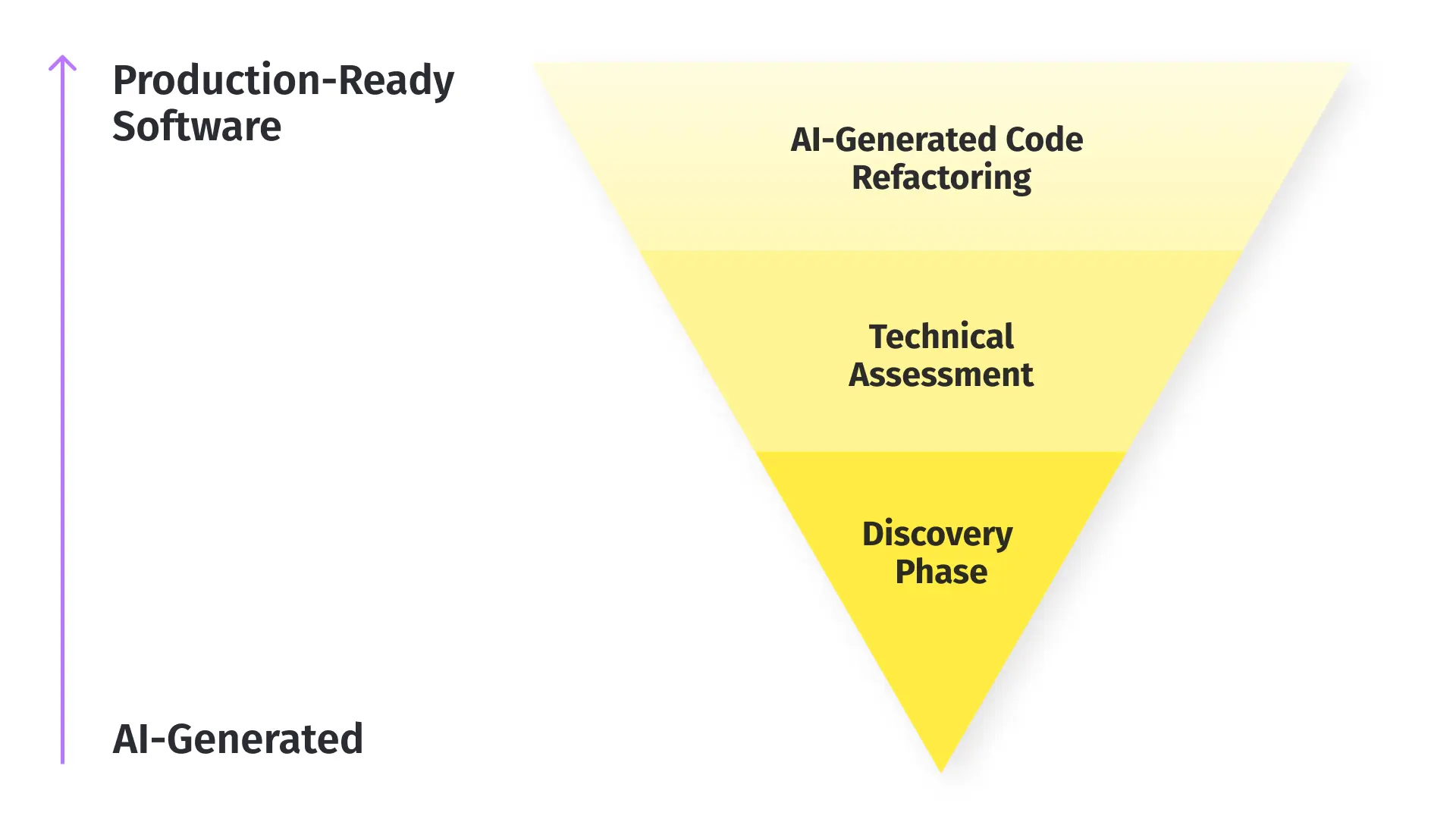
Next, a software architect performs a technical assessment. This senior specialist evaluates architecture, data models, security from an OWASP perspective, and overall code quality, including technical debt. The result of this phase is a structured report outlining what can be kept, what must be fixed, and what should potentially be migrated to a different tech stack. It also includes a list of issues and a recommended project roadmap.

After that, specialized engineers step in — you could call them vibe code refactoring engineers or AI code cleanup developers. These are programmers who gradually transform your prototype into a stable, production-ready system. They refactor AI-generated code step by step, improve architecture, strengthen security, and align the product with real-world scalability and performance requirements.

Illustration of the process from AI-generated code to production-ready software, showing a pyramid structure with Discovery Phase at the bottom, followed by Technical Assessment, and AI-Generated Code Refactoring at the top.

In addition, this phase often includes setting up proper logging, monitoring, and deployment pipelines — because without these fundamentals, even a good AI-generated idea cannot survive in production.

In the end, the goal is not to discard what was built, but to evolve it. A vibe-coded prototype can absolutely become a strong foundation for a real product — it just needs engineering discipline, structure, and the right level of refinement.

AI Assisted Software Development in Action

To wrap things up, it’s worth looking at how AI trends are actually used in professional engineering teams.

Experienced developers also use vibe coding in a way — or more accurately, AI assisted software development — but in a much more controlled and precise way. Instead of “just build me an app”, they give the AI small, well-defined tasks and use it like a smart pair programmer.

A big win is the automation of boring stuff. Testing, debugging, writing docs, finding edge-case bugs — all of this is now heavily supported by tools powered by AI in software development. It saves time, reduces costs, and helps teams ship faster without burning out.

Modern IDEs also come with built-in AI agents that understand project context. That’s basically where AI coding trends are heading — tighter integration, less guessing, more context-aware assistance, and fewer random hallucinations compared to early tools.

But here’s the catch: AI is still not fully reliable. It can suggest outdated patterns, deprecated libraries, or “technically correct but risky” solutions. That’s why professional engineers are still essential — someone has to validate, adjust, and sometimes completely reject AI suggestions.

This is where AI-driven development actually lands in real life: not replacing developers, but making them faster, more focused, and more strategic. The AI writes drafts — humans take responsibility for architecture, quality, and final decisions.

The Bottom Line

So you’ve got an AI prototype for investors, and now it’s time to fix the technical issues and take your product to the next level. That’s where we come in.

At Timspark, we help you bridge the gap between fast AI creation and real-world production. From a deep technical audit of your codebase to complete software stabilization and deployment, we ensure your idea doesn’t end up gathering dust on a shelf among countless other ideas.

Although you may face technical obstacles, especially around scalability, security, and architecture, it doesn’t mean you have to lose the benefits of vibe coding from the early stages. We help you keep the momentum, fix what needs fixing, and turn your AI-built prototype into a reliable, production-ready application that can actually scale.


Let’s turn your vibe into something real!

References

  1. The Vibe Coding Delusion: Why Thousands of Startups Are Now Paying the Price for AI-Generated Technical Debt.  TechStartups, 2025.

Top Web Development Software: Essential Guide

Top Web Development Software: Essential Guide

Tworzenie aplikacji internetowych is always changing, driven by fast-paced tech innovations, evolving consumer expectations, and businesses’ growing need to stay ahead with modern digital solutions.

For instance, global spending on public cloud services is set to experience significant growth, with the global SaaS market projected to rise from $197 billion in 2023 to $232 billion by 2024. Salesforce reports that 68% of consumers now expect enhanced digital experiences from businesses, a shift accelerated by the COVID-19 pandemic.

With remote and hybrid work models becoming increasingly common, tools that facilitate smooth collaboration and cloud-based integration are more important than ever.

The trend for global digital transformation is going to grow, supposedly reaching an estimated $3.4 trillion by the year 2026.


Navigating this dynamic landscape demands implementing the right tools. Therefore, choosing the best software for web development isn’t just a technical choice – it’s a strategic decision that can drive business success.

Choosing web development software: What to look for

The web development process includes coding complex and time-consuming tasks, from design to deployment and bug fixing. We’ve compiled a list of the best web development software. Grouped into categories by functionality and purpose, these web development apps are the most popular ones used to empower software developers i dedicated dev teams to build efficient web products.

We will cover the following types of web development software:


  • Code editors and Integrated Development Environments (IDEs)
  • Version control and collaboration systems 
  • Front-end frameworks and libraries
  • CSS frameworks and preprocessors
  • Backend tools
  • Testing and QA tools
  • Design and prototyping tools

Code editors and Integrated Development Environments (IDEs)

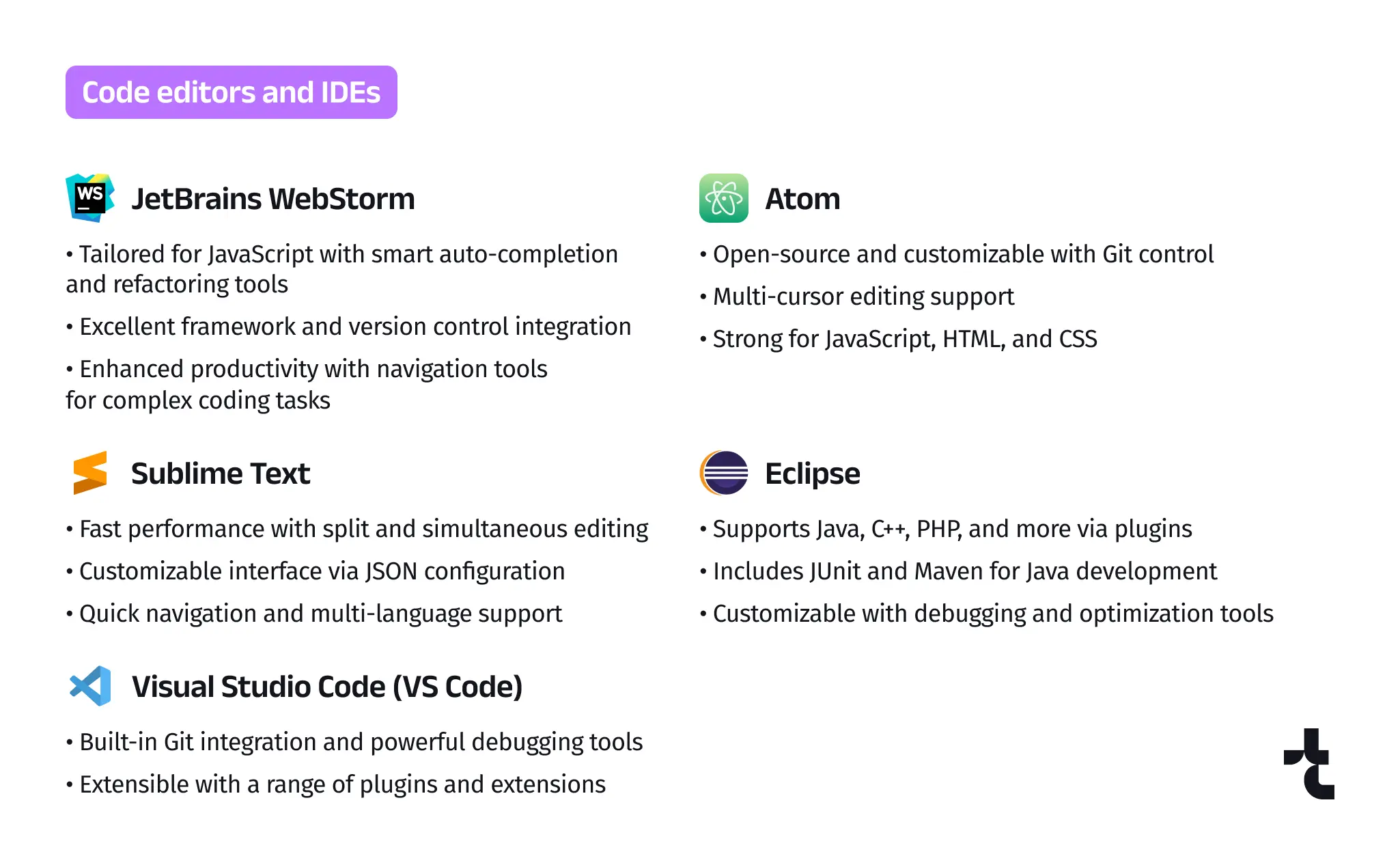
These programs are designed to simplify coding and improve efficiency at every stage of development. Code editors with their built-in features such as syntax highlighting, code auto-completion, and a debugger are mostly tailored for writing and editing code. IDEs take it a step further, offering an all-in-one solution for writing, testing, and managing code.

Top Web Development Software in 2025


Visual Studio Code (VS Code)

This open-source and cross-platform code editor developed by Microsoft can be considered a go-to choice for both frontend and backend development. With auto-complete, syntax highlighting, support for Git commands, various frameworks, libraries, and web development languages (JavaScript, TypeScript, Node.js, C++, C#, Python, PHP) it efficiently runs and debugs codes. To access the latest releases and features, one can download the Insiders version.


Sublime Text

Both beginners and experienced developers opt for this web development software due to its user-friendly interface and speed. It combines a range of advantages that enhance developers’ productivity without sacrificing performance:

– split editing (dividing the webpage into different sections);
– simultaneous editing (applying interactive changes to multiple selected areas);
– quick navigation to files, symbols, and lines;
– customization with JSON configuration files;
– support for Markup and other programming languages.


JetBrains WebStorm

It is a versatile web development software tailored for JavaScript developers which simplifies server, mobile, and web app development with features like autocomplete, automated refactoring, and powerful navigation tools. WebStorm supports various frameworks, integrates seamlessly with version control systems, and enhances productivity by streamlining complex tasks. Whether working on the front-end or back-end, WebStorm offers a smooth and efficient coding experience to help developers create high-quality applications.


Atom

This is one of the best web development platforms for editing text and source codes. Built by the GitHub community, it is open-source and provides built-in Git control and multi-cursor plug-ins.and supports web development languages like JS, HTML, CSS, and others.


Eclipse

It is a free, open-source IDE widely used for Java development but also supports multiple programming languages like C++, Python, and PHP through plugins. It offers powerful features:

– JUnit integration for testing
– Maven project management
– tools for debugging and refactoring.

Beyond coding, Eclipse includes frameworks for web, data, and performance optimization, catering to diverse web app development and other aspects of building web products. Flexibility with customization makes this IDE a versatile choice for developers working on complex, multi-language web products.


Version control and collaboration systems

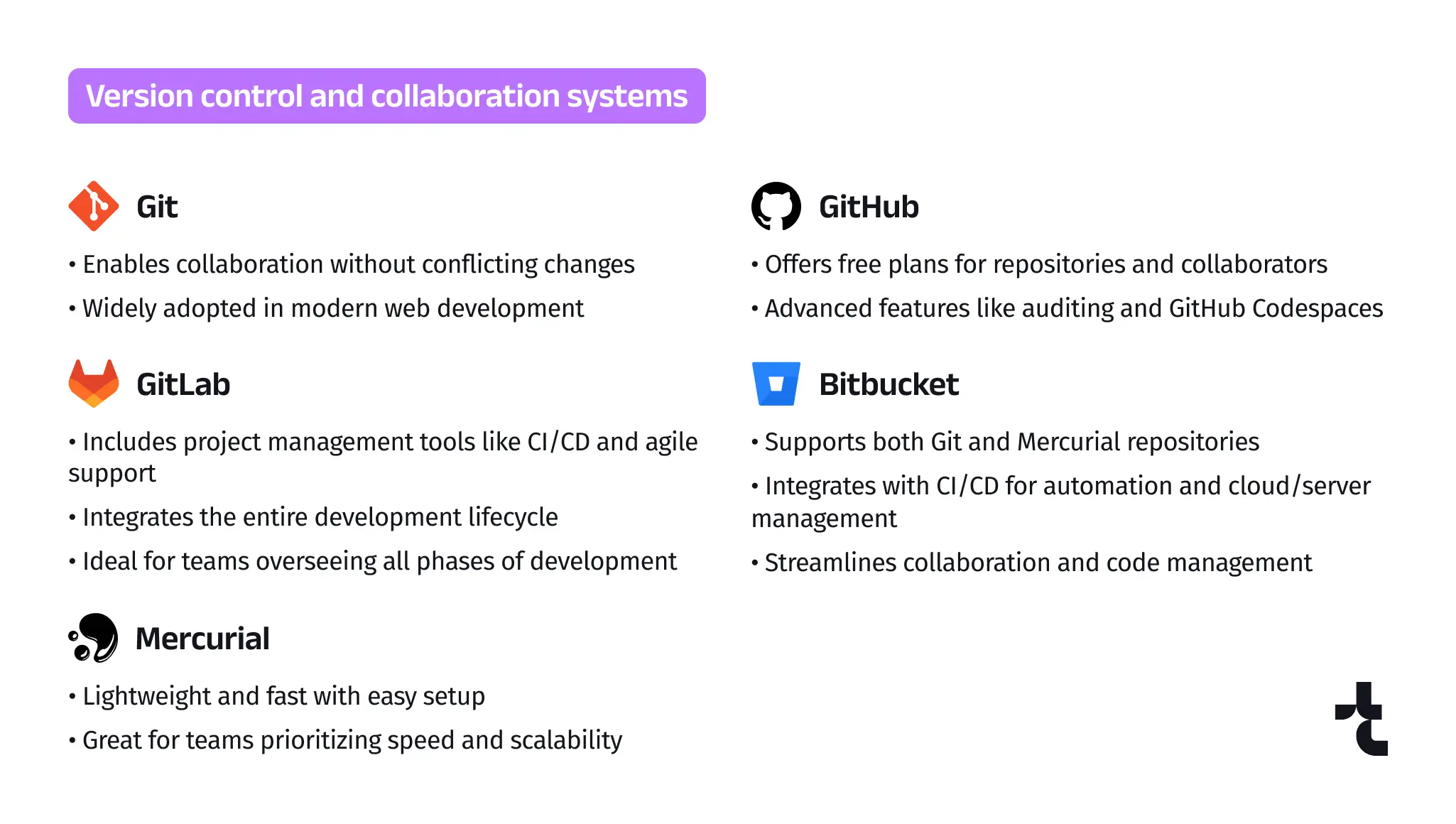
Version control and collaboration systems are naturally on the list of best tools for web development, being also an indispensable part for development teams. They help manage, share, and track code changes, improving communication in collaborative projects and thus ensuring engineers deliver reliable results.

Top Web Development Software in 2025


Git, GitHub, GitLab

Git is the most widely used distributed version control system in modern web development. It allows multiple developers to collaborate without the risk of conflicting changes by recording all the changes in a repository. However, Git alone isn’t enough for seamless collaboration and management—this is where platforms like GitHub i GitLab come in. They are not specifically web development platforms, but offer a range of possibilities in any kind of development process.

GitHub is a cloud-based platform that builds on Git’s version control system by offering a space to host, store, and manage code. Its cloud storage allows multiple developers to access and work on projects simultaneously. You can use its free plan for unlimited repositories and collaborators, or opt for paid plans offering advanced features like improved auditing and GitHub Codespaces.

GitLab is a platform for hosting Git repositories, but it also includes tools for project management, such as CI/CD (Continuous Integration/Continuous Delivery), agile methodology support, and detailed analytics. GitLab focuses on integrating the entire development lifecycle, enabling seamless collaboration from planning to deployment. It is the best web development software for teams that want to oversee all phases of development in a unified environment.


Mercurial

Similar to Git, It is a distributed version control system that allows developers to manage and track changes to their codebases. What makes one of the best software for web development is its focus on simplicity and performance. Its lightweight design and straightforward, easy-to-use interface allow for faster setup and fewer learning curves compared to other systems. Although it may not be as widely adopted as Git, Mercurial has proven as a valuable web development software, especially for those development teams who prioritize speed, simplicity, and scalability.

Bitbucket

It is a powerful code hosting and collaboration tool designed to streamline the development process for web teams. It supports both Git and Mercurial repositories, enabling developers to manage their source code with ease. Bitbucket integrates seamlessly with CI/CD, providing solutions for automation, cloud, and server management. 

Front-end frameworks and libraries

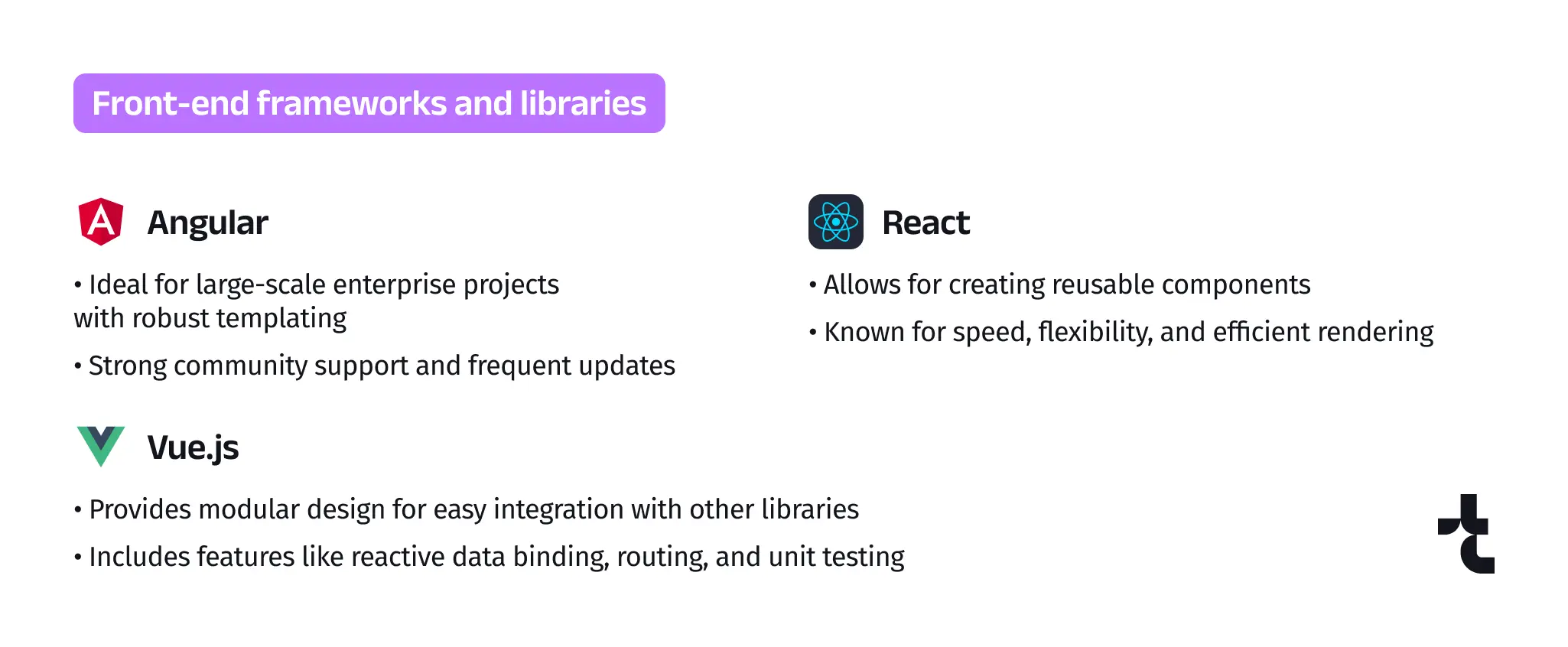
Developing faster, ensuring consistency, and keeping the product aligned with the industry standards – these are some of the main tasks frameworks and libraries are supposed to solve. By offering pre-built components and templates, frameworks like React, Angular, and Vue.js allow developers to focus on core functionality while ensuring speed and maintainability. Libraries, on the other hand, provide focused, reusable code to solve specific problems, making it easier to implement complex features quickly.

Top Web Development Software in 2025

React

React is a popular JavaScript library used for building interactive user interfaces. It allows developers to create complex UIs by breaking them down into smaller, reusable components. React is known for its speed, flexibility, and efficient rendering, making it a widely adopted tool for web app development.

Angular

Angular is a powerful framework for building dynamic, client-side applications using such languages as HTML and TypeScript. It’s particularly well-suited for large-scale enterprise projects, as its templating system allows developers to build robust and scalable applications efficiently. Strong community support and frequent updates add up points to its position in the list of best web development software.

Vue.js

Vue.js is a versatile JavaScript library that focuses on building user interfaces and the view layer of applications. Its modular design allows seamless integration into existing projects or use alongside other libraries. Vue.js offers robust features like reactive data binding, routing, and unit testing, making it versatile for developing everything from small components to full-scale, cross-platform applications.

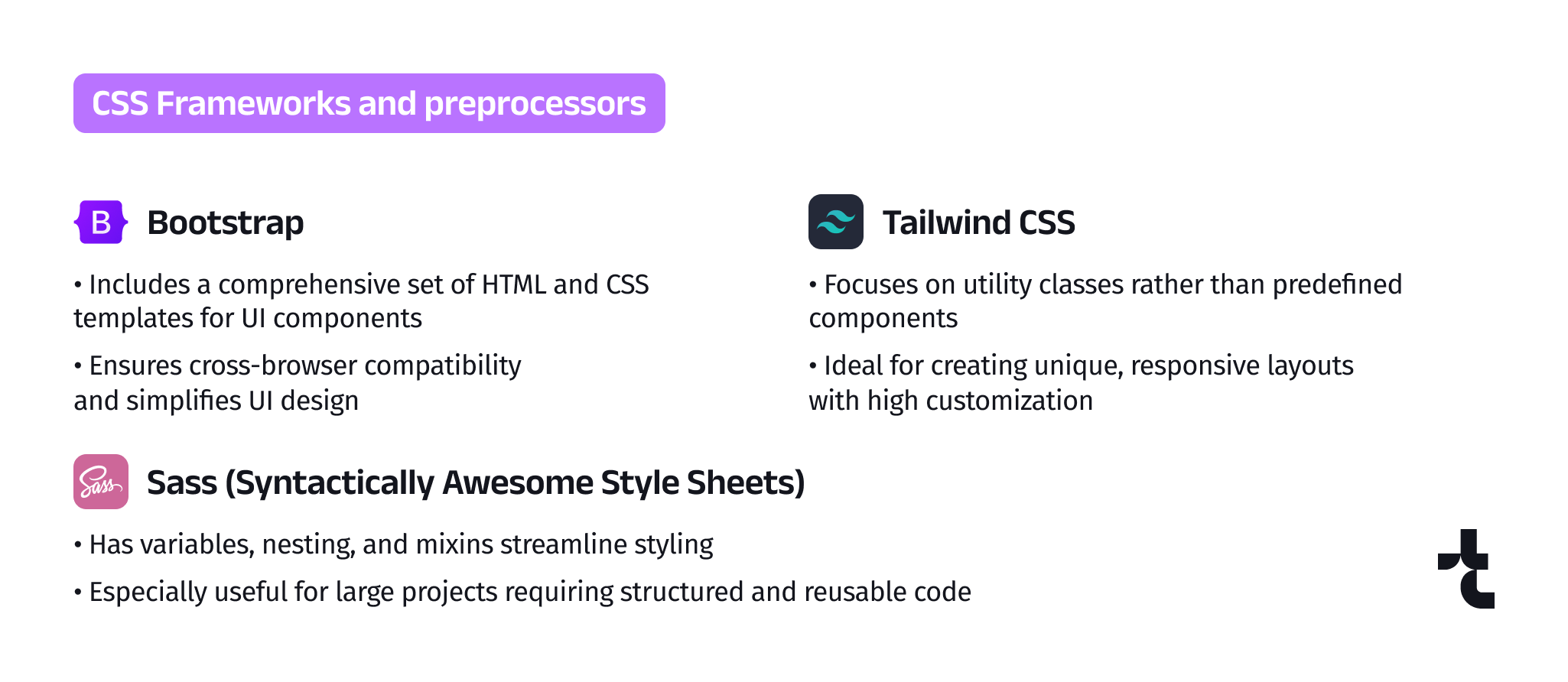
CSS frameworks and preprocessors

CSS frameworks are powerful web development software providing pre-designed components, grids, and layouts. They allow developers to streamline web page styling and create responsive and visually appealing designs without starting from scratch. Preprocessors take CSS to the next level with variables, nested rules, and functions. These features keep stylesheets organized and easier to maintain, especially for larger projects. When frameworks are combined with preprocessors, developers can create efficient, flexible web designs that are easier to scale.

Top Web Development Software in 2025

Bootstrap

Bootstrap is the most widely used open-source framework for creating responsive, mobile-first websites. It provides a comprehensive set of design templates based on HTML and CSS, covering essential components such as typography, forms, buttons, navigation, and more. This powerful front-end framework ensures cross-browser compatibility and simplifies the design of UI elements like headers, footers, and navigation menus.

Tailwind CSS

Tailwind CSS is a highly flexible, utility-first CSS framework designed to help developers create custom user interfaces without the need to write traditional CSS code. Unlike other frameworks that come with predefined components, Tailwind focuses on providing utility classes that can be applied directly in HTML. This helps design unique, responsive layouts and components and makes it an ideal web development software for projects that require a high level of customization without being constrained by pre-built styles.

Sass (Syntactically Awesome Style Sheets)

Sass is a powerful and widely used CSS preprocessor that enhances the functionality of traditional CSS. It allows developers to write more efficient and maintainable code by introducing advanced features like variables, nesting, and mixins. These features help streamline the styling process, making it easier to create dynamic and reusable styles. Sass is particularly valuable for larger projects, where complex CSS can benefit from more structured and organized code.

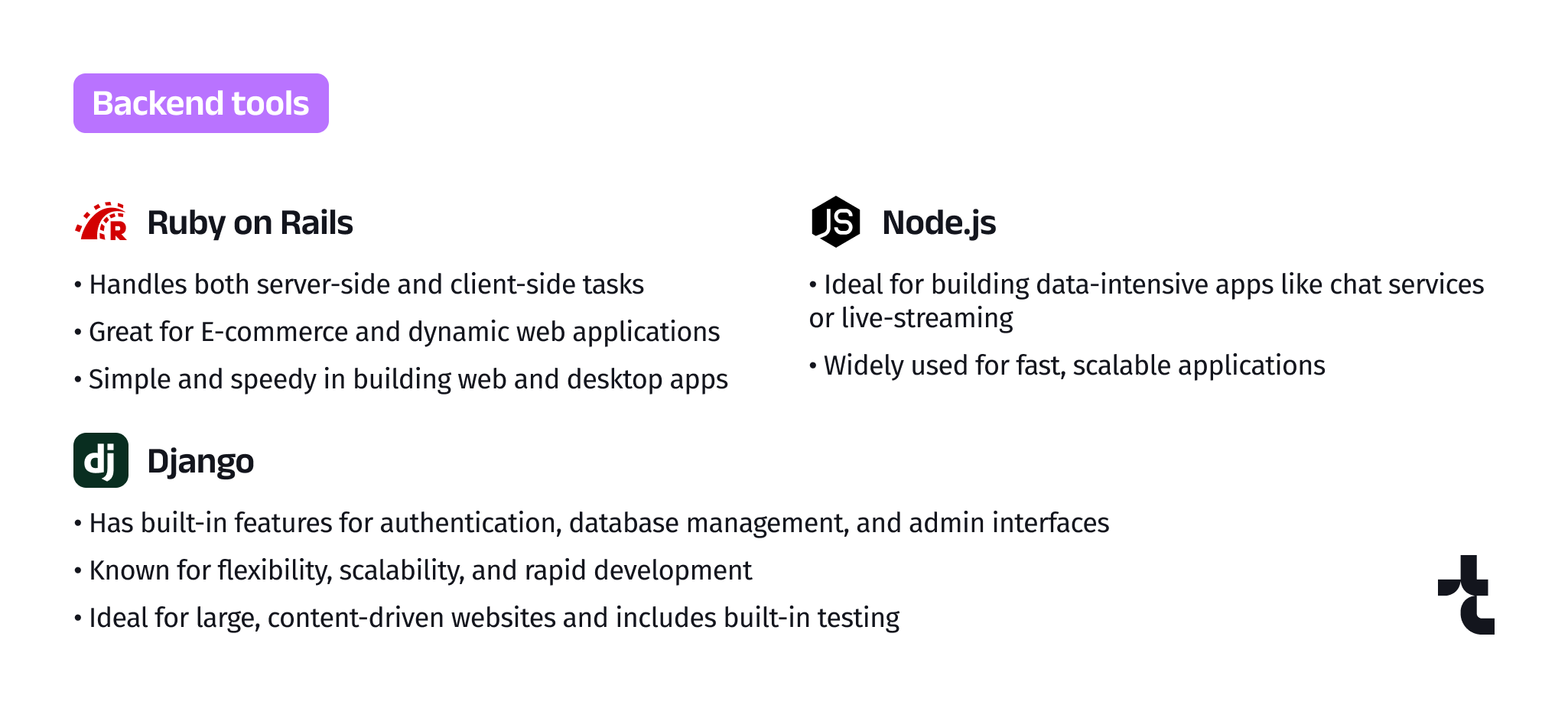
Backend tools

You cannot miss them if you aim to build robust and secure web applications. Technologies like Node.js, Django, and Ruby on Rails are some of the most widely used frameworks for managing the server-side functionality.

Top Web Development Software in 2025

Node.js

It is an open-source, cross-platform environment that enables engineers to run JavaScript on the server side. Notably, Node.js is still the most popular web development framework, with around 40% of developers using this framework. It’s particularly popular for building data-intensive applications like chat apps or live-streaming services.

Django

This high-level web development framework for Python offers a range of built-in features such as user authentication, database management, and an admin interface, making it ideal for rapid development. Django is known for its flexibility, extensibility, and scalability, which has made it a popular web development software for large, content-driven websites like Netflix. Additionally, its built-in test framework helps developers quickly create and run unit tests, ensuring the reliability of the code.

Ruby on Rails

It is a popular full-stack web development framework built with Ruby which handles both server-side tasks, such as managing databases and file storage, and client-side tasks, including rendering HTML and updating web pages in real-time. For this reason, it is known as one of the best tools for web development when it comes to e-Commerce desktop and web applications.


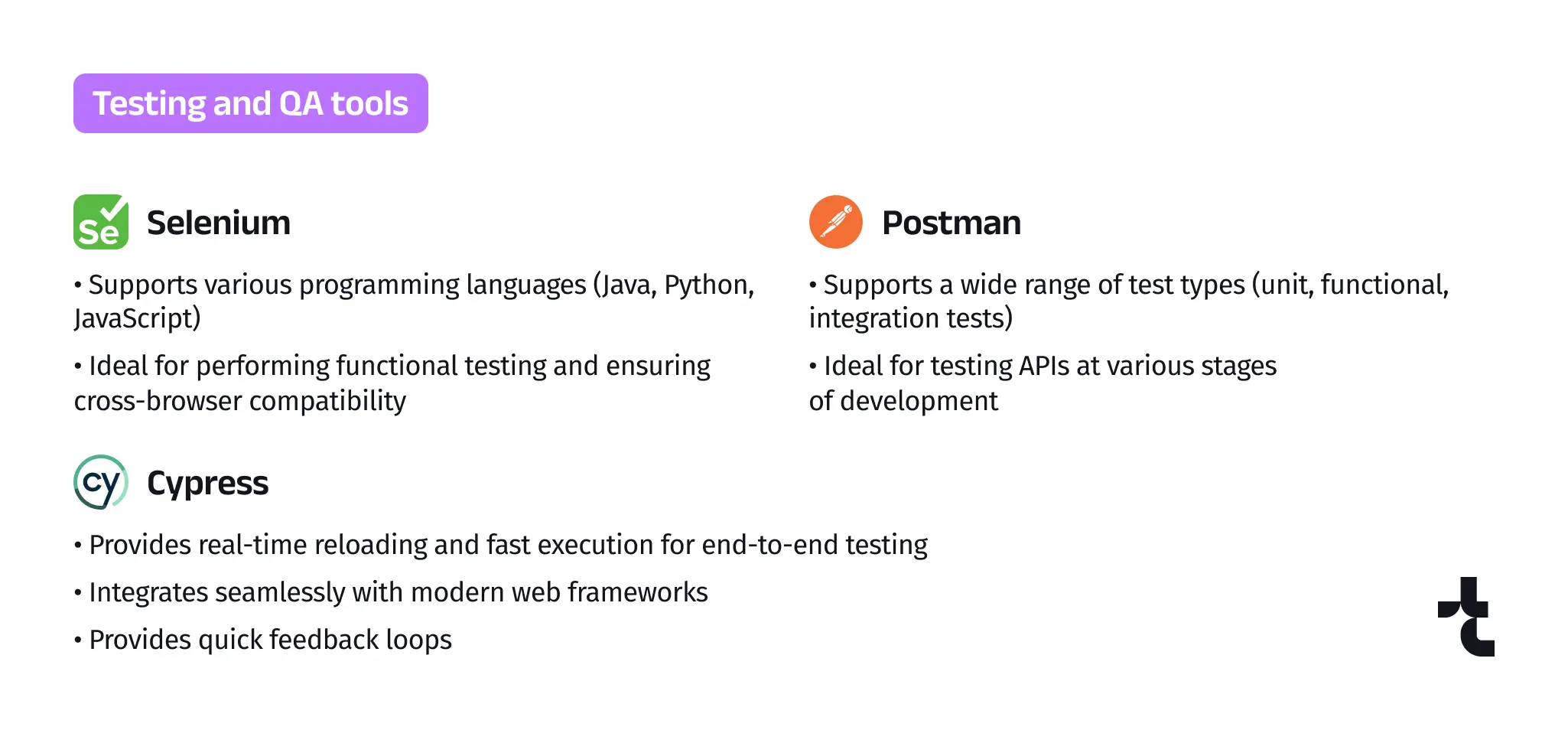
Testing and QA tools

QA tools mainly help test the app’s core functionality and ensure that software is robust, reliable, and ready for users before the launch. Their second, no less valuable role is streamlining the QA i testowanie process by automating repetitive tasks, catching bugs, improving scalability, and boosting overall team productivity.
Top Web Development Software in 2025

A popular open-source tool for automating web browsers, Selenium allows testers to perform functional testing across multiple browsers and platforms. It supports various programming languages like Java, Python, and JavaScript, making it a versatile web development software for many teams.


Cypress

This modern testing framework addresses common challenges faced by QA teams, offering developers a platform for end-to-end testing with the following functionality:

– real-time reloading
– fast execution
– integrations with modern web frameworks

It is a great option among web development software providing an intuitive setup and fast feedback loops for developers.


Postman

Postman is a comprehensive tool that simplifies building, testing, and managing APIs. It enables developers to create and execute both manual and automated tests of different kinds: unit tests, functional tests, integration tests, end-to-end tests, regression tests, mock tests, making it applicable at various stages of development.


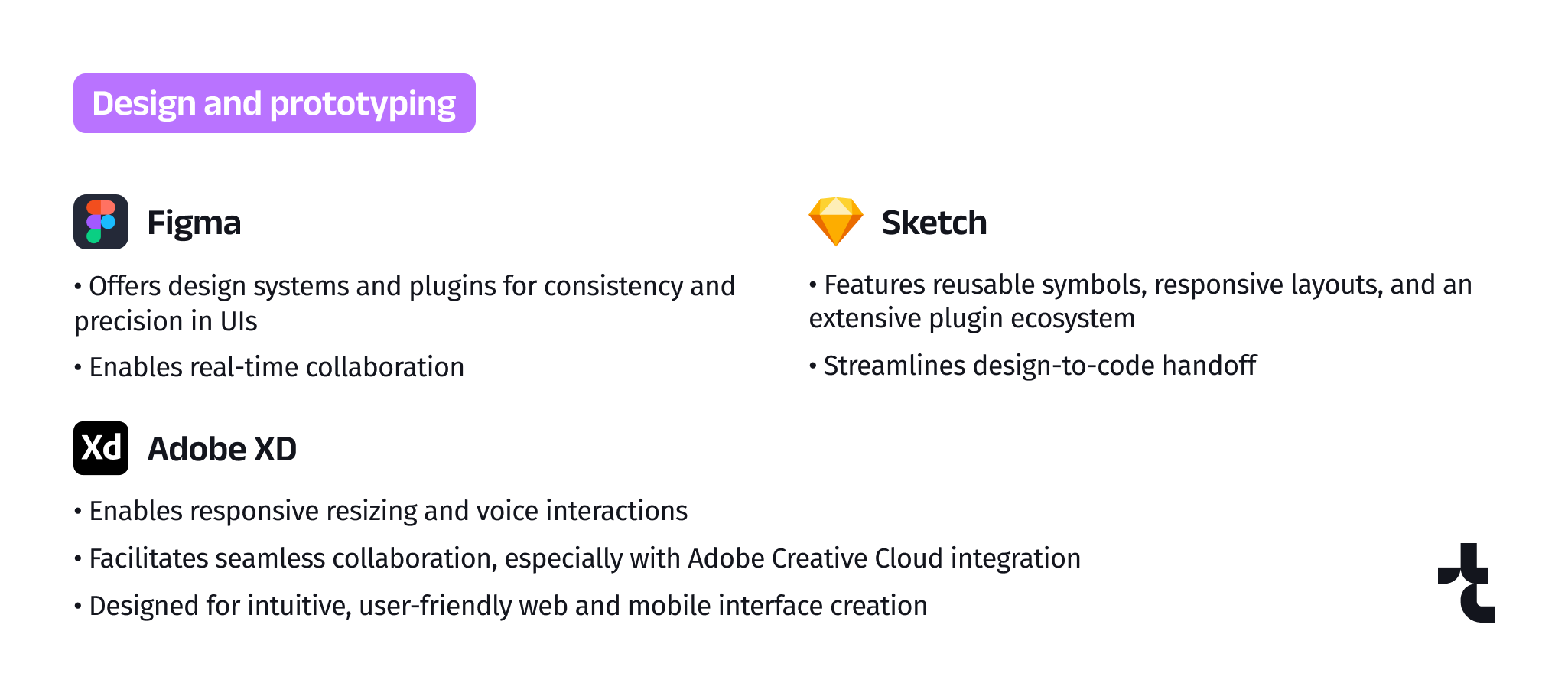
Design and prototyping tools

These web development tools help create visually appealing, user-friendly, and functional products fast and with fewer revisions. Their core task is managing interactive prototypes, wireframes, and UX/UI design projects.

Top Web Development Software in 2025


Figma

It is a dynamic, cloud-based tool for crafting responsive designs and interactive prototypes. Figma is perfect for web development, as it empowers teams to collaborate in real-time, reducing bottlenecks and streamlining workflows. With robust features like plugins and design systems, Figma ensures consistency and precision in user interfaces.


Adobe XD

Adobe XD is a dynamic design and prototyping tool built for creating web and mobile interfaces. With features like responsive resizing, voice interactions, and seamless collaboration, it empowers developers to craft intuitive, user-friendly designs. Its integration with Adobe Creative Cloud ensures a smooth workflow from concept to development.


Sketch

Sketch is a sleek, vector-based design tool tailored for creating modern web interfaces. Loved for its simplicity and precision, it offers reusable symbols, responsive design layouts, and a plugin ecosystem to streamline workflows. With collaboration features and easy handoff tools for developers, Sketch ensures smooth transitions from design to code, making it a go-to choice for web development projects.


AI in web development: Building smarter

Harnessing AI for web development is no longer a rare case. A wide range of tools and platforms can elevate both the user experience and the development workflow for your web products. Depending on your project’s needs and goals, AI can be implemented in several effective ways.


1. Ready-made AI-powered services that can enhance your web product

If you wish to offer users a more interactive and personalized experience, there are tools that can be easily integrated into websites and apps. For instance, platforms like Amazon Alexa Skills, Google Cloud Speech-to-Text, or IBM Watson provide such features as speech recognition, voice commands, and voice search. AI-driven chatbots provide 24/7 customer service, making your web product more accessible and interactive.

2. AI platforms assisting in developing a product

AI platforms can offer support to developers at every stage of the web development lifecycle. For instance, tools like Uizard or Figma empowered with AI plugins can automate design processes by generating layouts, color schemes, and component suggestions. Learn more about the impact of AI on design in this comprehensive guide on AI-Driven UX/UI Trends.

GitHub Copilot assists developers by auto-completing code, suggesting snippets, and detecting errors, while AI-powered testing tools like Testim use machine learning to automate UI testing, bug detection, and performance checks.


3. AI as a Service (AIaaS)

These are tools and services that provide AI capabilities and free you from the need to build or maintain AI infrastructure from scratch. With AIaaS platforms developers can get access to pre-trained models, machine learning services, and APIs. Thus, a wide range of AI features such as natural language processing, image recognition, and predictive analytics, can be implemented directly into web products. AWS SageMaker i Google Cloud AI are only a few in a range of such AIaaS platforms.


Conclusion

Staying updated with evolving technologies and incorporating the right mix of frameworks, libraries, and testing solutions is not only about simplifying complex tasks. It is the source empowering both software developers i dedicated teams in creating seamless, user-focused experiences.

Want to build innovative web solutionswith the perfect tech stack?

AI development services

References


  1. 65 + Cloud Computing Statistics You Need to Know For November 2024, Technopedia 2024
  2. Why Customer Engagement Will Never Be the Same, According To 15,600 of Them, Salesforce 2020
  3. Spending on digital transformation technologies and services worldwide from 2017 to 2027, Statista 2024
  4. Most used web frameworks among developers worldwide, as of 2024, Statista 2024