


From Prototype to Production:
Why Software Delivery Still Fails
LAST UPDATED: sierpień 20, 2026
TIMSPARK RESEARCH SERIES – PART 2 OF 2
Qualitative research based on 20 interviews with technology and business leaders across Europe and international markets.
How to read this research
Timspark Innovators interviews are the primary qualitative evidence. Gartner sources are used for analyst forecasts and survey-based comparison. Forbes sources are used as indicators of wider executive and technology commentary, not as equivalent statistical evidence. Apparent contradictions are retained where they reveal differences by industry, company maturity, risk level or geography.
Research question and executive findings
Why do technically capable teams still struggle to ship, scale, and sustain software products? The interviews show that the persistent delivery problem is not a lack of tools. It is the difficulty of aligning scope, decisions, specialist talent, users, quality, regulation, and external partners around one operating model.
-
-
- Delivery slows when decisions, feedback, and access move more slowly than engineering.
- A prototype becomes a product only after industry-specific risks and workflows are addressed.
- The market needs broad ownership and deep specialization at the same time; the solution is a composable team rather than a universal individual.
- External teams create value when they add governed capability, not when they are treated as inexpensive headcount.
- Modernization fails when organizations select a destination before understanding architecture, cost, people, and workflow.
- Remote work reduces geographic constraints but does not remove the value of proximity, shared context, and regional trust.
-
Software delivery is an organizational system. Engineering velocity is only one of its variables. AI introduces another layer to this system. Part One examines the data, governance, privacy, and human judgment behind enterprise AI readiness.
Methodology and limitations
Part Two uses the same 20-interview qualitative corpus, with greater emphasis on delivery, product readiness, modernization, team design, and sourcing models. The analysis aggregates evidence by operating problem and industry rather than attributing conclusions to individual interviewees. Industry differences are retained because an effective model for a small creative studio may be unsafe for a medical platform, inefficient for a regulated bank, or too rigid for an early-stage product company. The research identifies patterns and contradictions; it is not a statistically representative survey.
FINDING 1 The real cost of speed is scope and decision latency Teams often lose more time to unclear decisions and expanding commitments than to technical execution. |
FINDING 2 Production readiness is defined by the industry The same technical prototype faces different thresholds in games, healthcare, agriculture, mobility, finance, and HR technology. |
FINDING 3 The specialist-generalist contradiction Lean teams need broad ownership; high-risk systems need deep specialization. Both statements can be true. |
FINDING 4 What should remain in-house? Strategic context, architecture, and accountability tend to stay close; scarce and variable capabilities are more open to external partnership. |
FINDING 5 Modernization begins with diagnosis Replacing old technology without understanding workflows, people, costs, and risk can make the organization less capable. FINDING 6 Geography still shapes delivery Remote work expands the talent market, but regulation, time zones, localization, and trust continue to affect the practical value of a partner. |
Topic | Interview finding | Gartner signal | Forbes signal |
Engineering teams | Smaller teams work only when they retain access to specialist depth. | AI-native platforms will make teams smaller and more nimble. | Role convergence and T/E-shaped skills will increase. |
Modernization | Diagnosis and operating capacity matter more than fashionable architecture. | Cloud dissatisfaction rises with poor strategy and uncontrolled cost. | Model and tool choice should follow use case and risk. |
External partners | Capability, integration, and governance matter more than cheap headcount. | Sovereignty and regional context increasingly influence provider selection. | Executive narrative increasingly emphasizes practical value over hype. |
Production readiness | Industry risk and workflow define release readiness. | Agent projects fail when value and controls are unclear. | Agent adoption is expected to accelerate, but barriers remain. |
1. The real cost of speed is scope and decision latency
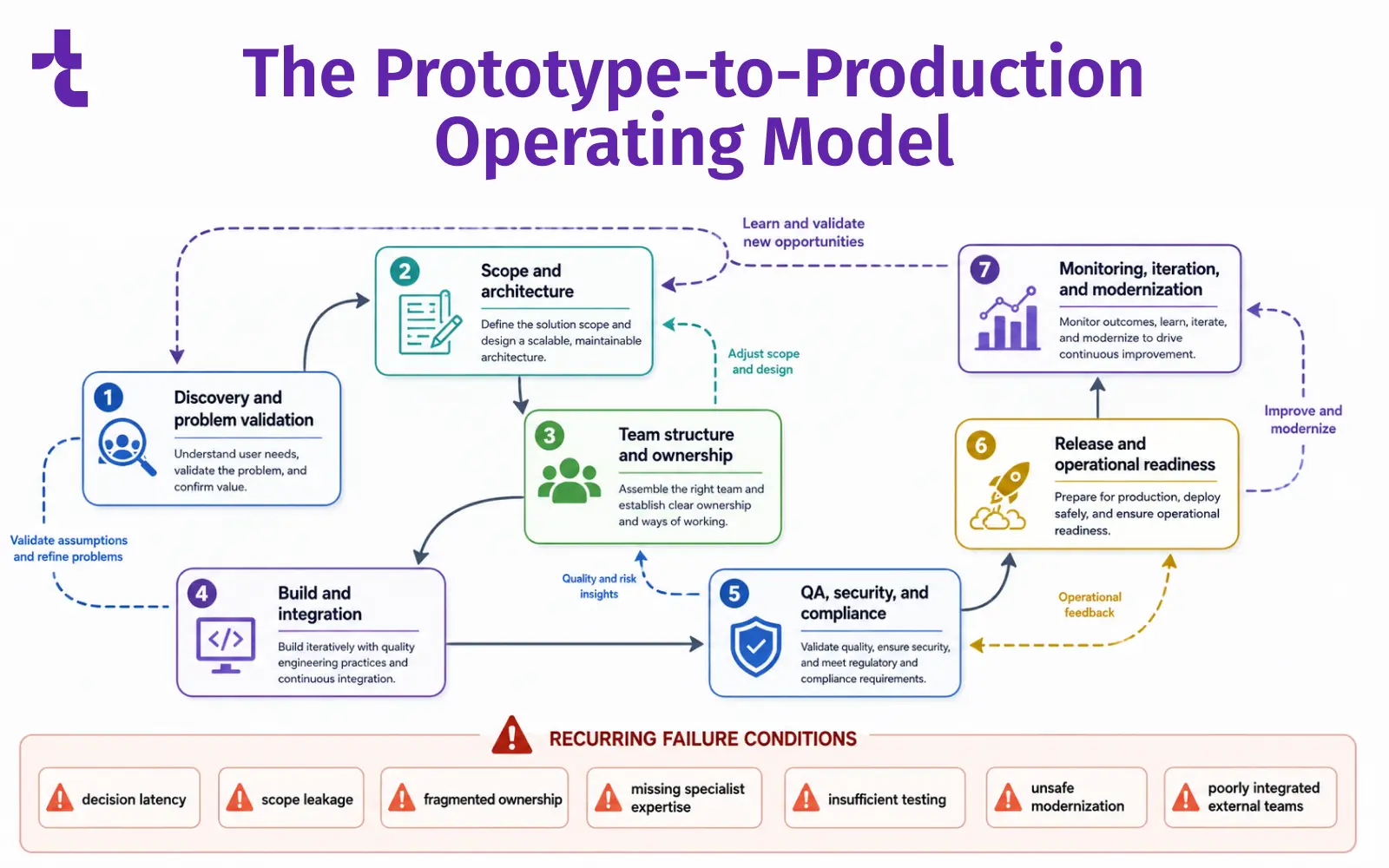
The interview corpus challenges the assumption that engineering velocity is the main determinant of delivery speed. Projects often slow because approvals, feedback, system access, and scope decisions move more slowly than implementation. The visible delay appears in engineering, but the cause sits in the wider organization.
Decision latency creates several forms of waste at once. Engineers wait, switch context, or proceed on assumptions. Work that was technically correct may need to be revised after late feedback. Delivery forecasts become unreliable because cycle-time metrics capture active development but not the time spent waiting for a decision owner.
Scope leakage produces a related problem. Fast delivery can create momentum and invite additional requests, but each addition consumes design, implementation, testing, documentation, and operational capacity. In small creative teams, one feature can become a system that prevents release. In enterprise projects, apparently modest additions can create technical debt and team fatigue.
Public-sector contracts intensify the issue because specifications are often written before implementation reveals the full operational detail. Requirements become clearer during delivery, while the budget and deadline remain fixed. Teams then have to distinguish essential functionality from lower-value additions and reprioritize without compromising the public outcome.
The strongest counterexample in the corpus is disciplined expectation management. When capacity, scope, and time-zone constraints are made explicit early, teams can protect a sustainable rhythm and avoid treating overtime as a normal delivery mechanism.
The common lesson is that cycle time should include waiting, access, approval, scope additions, and rework. AI can accelerate artifact creation, but it cannot compensate indefinitely for an organization that cannot decide.
2. Production readiness is defined by the industry
A working prototype proves that an idea is technically possible. Production readiness proves that the complete product can operate within the risk, workflow, commercial, and trust conditions of its industry. The interviews show that these conditions vary substantially.
In games and interactive products, readiness includes onboarding, UI clarity, performance, QA, localization, certification, and market visibility. A static concept can look excellent and still fail inside a real user flow. The practical implications can be compared with Timspark’s Unity mobile game development case, where external specialists were integrated into an existing creative and engineering workflow.
In healthcare, the threshold is much higher. Secure data, accessibility, clinical impact, quality-management procedures, supplier controls, code review, multiple test environments, reimbursement and regulatory documentation may matter more than feature velocity. A design that works for a consumer application may be unusable for an elderly patient or unacceptable in a clinical workflow.
The complexity is visible in a 3D medical imaging software project that combined machine learning, medical data formats, secure storage, backend engineering, QA, and clinician-facing tools. The value came from the integrated system and workflow, not from one technical component.
In agriculture, a product has to survive physical conditions. Hardware, connectivity, image capture, AI detection, microclimate data, and agronomic advice must work together outside a controlled pilot. In public mobility, readiness also includes citizen trust, fiscal rules, payment security, and operational scale. In HR technology, relevance, transparency, and a credible human process around the algorithm influence adoption.
These differences explain why QA outsourcing and software testing cannot be reduced to defect detection. Test strategy needs to reflect user behavior, integrations, performance, compliance, data risk, and the consequences of failure in the target sector.
Production readiness is therefore not a universal checklist. It is the point at which a product fits the operating reality and risk threshold of the environment in which it will be used.
3. The specialist–generalist contradiction
The corpus contains a real disagreement about team shape. Some lean software organizations need engineers who can work across front-end, back-end, databases, cloud, and business context. Regulated and safety-critical environments protect deeper specialization because errors carry greater consequences and formal role boundaries support quality.
The hardest roles are frequently hybrid rather than universal. Examples include technical UI designers who bridge engineering and visual systems, integration specialists who combine technical depth with partner communication, automation QA engineers who can both test critically and write code, and data or AI specialists who understand the industry in which the model operates.
This suggests that broad ownership and universal mastery should not be confused. Teams benefit when specialists understand adjacent areas and can share delivery responsibility. They become fragile when one person is expected to be an expert in every technology, domain, quality practice, and infrastructure layer.
The strongest operating pattern is the composable team: deep specialists, selected bridge roles, enough adjacent knowledge to reduce handover friction, and access to fractional expertise when the capability is important but not required full-time.
This model provides a more precise response to the global IT skills shortage. The shortage is not simply a lack of developers. It is a shortage of senior judgment and combinations of skills that are difficult to produce through rapid reskilling.
Gartner expects AI-native platforms to support smaller, more adaptable engineering teams. Forbes and Forrester commentary similarly anticipate role convergence and T- or E-shaped profiles. The interview evidence adds a qualification: smaller teams still need dependable access to deep expertise, even when it is not permanent or full-time. [G1] [G4] [F1]
4. What should remain in-house?
The research does not support a general movement either toward or away from outsourcing. It shows a more selective division between strategic core knowledge, permanent operational capability, variable capacity, and scarce specialist input.
Companies tend to retain architecture, business logic, sensitive integrations, compliance ownership, and the knowledge that differentiates the product. They use external partners for specialist expertise, temporary demand, independent workstreams, or capabilities that would be inefficient to hire permanently.
This is the strongest use case for Rozszerzanie zespołu IT: bridging a specific capability gap while the client retains product ownership and governance. The model is weaker when it is treated only as inexpensive headcount or when external specialists operate outside the client’s delivery and quality system.
Longer-term products may require a dedicated development team that shares roadmap responsibility, communication cadence, and quality expectations. The distinction is not the employment label; it is the level of ownership and integration required.
The corpus also supports fractional models. A compact product team may need senior DevOps, architecture, security, data, or QA expertise for a limited number of hours rather than as a full-time role. This can preserve specialist quality without adding fixed capacity that the product cannot use consistently.
External relationships work best when problems are disclosed early, responsibilities and decision rights are explicit, and contractors use the same onboarding, code review, documentation, and delivery controls as internal engineers. A partner should add governed capability rather than create a new coordination layer.
The sourcing decision can be supported by an educational guide to staff augmentation, but the final classification should be made capability by capability: strategic core, permanent operation, variable capacity, or scarce specialist input.
5. Modernization begins with diagnosis
The interviews repeatedly reject modernization strategies that begin with a predetermined cloud provider, framework, or complete rewrite. Old systems contain integrations, business rules, user habits, and organizational knowledge that may not be documented elsewhere.
A structured project discovery and technical assessment should examine architecture, dependencies, usability, test coverage, security, data, operating cost, and the capabilities of the team that will maintain the target system.
The organization can then make a portfolio of decisions: retain stable components, refactor constrained layers, isolate high-risk dependencies, migrate suitable workloads, and replace only what no longer supports the business. A technically modern stack can still be the wrong destination if the team cannot operate it or if the transition destroys valuable knowledge.
Cloud transformation should be tied to measurable outcomes through cloud migration consulting services: performance, resilience, security, cost control, scalability, or faster delivery. Changing the vendor name on the infrastructure is not by itself modernization.
The same principle applies to delivery infrastructure. DevOps consulting services can improve CI/CD, infrastructure as code, monitoring, environment management, and operational ownership, but the tools should follow the assessed bottleneck rather than lead the transformation.
Modernization should also be connected to a plan for reducing technical debt with DevOps. Technical debt becomes economically relevant when it slows changes, raises incident risk, prevents integration, or makes the system too expensive to understand and operate.
Open-source tools and frameworks require the same contextual assessment. They can be appropriate for startups and standard use cases, but enterprise or regulated products need to consider maintenance, community health, security updates, deprecation risk, and the cost of replacing a dependency later.
Gartner predicts increasing cloud dissatisfaction where expectations are unrealistic, implementations are weak, or cost is uncontrolled. The corpus supports a practical response: modernization is an operating-model decision supported by technology—not a technology purchase that automatically changes the operating model. [G6]
5. Geography still shapes delivery
Remote work has expanded access to talent and enabled international delivery, but the interviews do not support the idea that geography has become irrelevant. Different work requires different degrees of synchronous communication, cultural context, time-zone overlap, and physical proximity.
Execution with stable requirements can work effectively across distributed teams when documentation and decision outcomes are visible. Creative discovery, crisis response, trust-building, and the early stages of product definition may benefit from more synchronous or in-person interaction. Leadership also loses some informal signals when all communication is mediated by scheduled calls and written tools.
European proximity can create practical value through working-hour overlap, regulatory familiarity, multilingual capability, and easier integration with customer organizations. This is a stronger proposition than labor cost alone, particularly in financial services, healthcare, public infrastructure, and other regulated sectors.
Localization adds another geographic layer. It is not only translation. Products may need to account for regional language variants, reading patterns, data conventions, payment expectations, platform certification, accessibility, and the way local institutions structure the customer journey.
The European market also presents a scale problem. Companies can be technically strong while repeatedly adapting certification, reimbursement, language, and commercialization processes across national borders. By contrast, major U.S. ecosystems concentrate customers, investors, technical talent, and rapid market feedback in the same geography.
The breadth of delivery contexts represented in Timspark’s software project portfolio shows why sourcing and product decisions should be matched to industry, risk, and geography rather than reduced to a single global operating model.
Gartner’s sovereign-cloud and region-specific AI forecasts indicate that infrastructure and vendor geography may become more important even as collaboration remains remote. European providers can use sovereignty, regulation, specialization, and proximity as differentiators, but they need globally competitive product and delivery discipline. [G5] [G8]
From analyst forecasts to operational reality
Where the findings align
The corpus supports Gartner’s view that AI-native development will change team structures, that cloud value depends on governance and realistic expectations, and that sovereignty will influence vendor selection. It also supports Forbes and Forrester commentary on role convergence and the movement of human work toward orchestration and systems thinking.
Where the narrative is too simple
Global discussions often imply that faster coding leads directly to faster delivery. The interviews show that scope, decision latency, stakeholder access, quality obligations, and market readiness frequently dominate cycle time. Coding acceleration can expose these organizational constraints rather than remove them.
Where operating models legitimately conflict
Some companies need broad generalists; others need protected specialist tracks. Some prioritize in-house cohesion; others rely on fractional partners. Remote work improves retention in one environment and weakens creative collaboration or leadership visibility in another. These are not inconsistencies to eliminate. They are evidence that operating-model choices need to follow product risk, scale, and work type.
Research implications
- Measure decision latency, waiting time, scope additions, and rework alongside engineering throughput.
- Define production-readiness criteria by industry before approving a pilot or MVP roadmap.
- Build composable teams with specialist depth, bridge roles, adjacent knowledge, and fractional expertise.
- Classify capabilities as strategic core, permanent operation, variable capacity, or scarce specialist input before sourcing.
- Require external teams to share the delivery and quality system rather than operate as a disconnected task queue.
- Begin modernization with architecture, workflow, risk, cost, data, and skills assessment—not a predetermined platform.
- Match remote, hybrid, and in-person collaboration to the work being performed.
- Position European delivery through regulatory knowledge, proximity, specialization, and trust rather than cost alone.
Conclusion
The persistent software-delivery problem is not a shortage of tools. It is the difficulty of aligning scope, decisions, talent, users, quality, regulation, legacy systems, and partners around one operating model. Organizations facing this complexity may use custom software development services to combine discovery, architecture, engineering, QA, DevOps and product ownership within one governed delivery system.
The path from prototype to production is not a technology handoff. It is an organizational alignment problem.
References
Gartner entries are official Gartner Newsroom publications. Forbes entries are contributor or analyst commentary and are used to compare the interview findings with the wider technology narrative.
[G1] Gartner Identifies the Top Strategic Technology Trends for 2026
[G2] Gartner Survey Finds AI Will Touch All IT Work by 2030
[G3] Gartner Predicts Over 40% of Agentic AI Projects Will Be Canceled by End of 2027
[G4] Gartner Identifies the Top Strategic Trends in Software Engineering for 2025 and Beyond
[G5] Gartner Says Worldwide Sovereign Cloud IaaS Spending Will Total $80 Billion in 2026
[G7] Gartner Says Lack of Semantics Causes Inaccurate AI Agents and Wasted Spending
[G8] Gartner Predicts 35% of Countries Will Be Locked Into Region-Specific AI Platforms by 2027
[G9] Gartner: Global AI Regulations Fuel Billion-Dollar Market for AI Governance Platforms
[F1] Forbes / Forrester: AI Does Not Replace the Development Workforce – It Changes It
[F2] Forbes: How to Get Your Business Data Ready for AI Agents
[F3] Forbes: The 8 AI Agent Trends for 2026 Everyone Must Be Ready For
[F4] Forbes: The Biggest Barriers Blocking Agentic AI Adoption
[F5] Forbes: Why Picking the Best AI Model Is the Wrong Question in 2026